By: Rev. Dr. Patrick R. Devine, International Chairman, Shalom-SCCRR.
Shalom-SCCRR is an inter-religious non-governmental organization that works in Africa; mainly, in the Eastern Africa member countries of the Intergovernmental Authority on Development (IGAD). Shalom’s vision is a society in which peace, justice and reconciliation prevail throughout Africa. Its mission is to work for a society free of physical violence and unjust social structures in Africa. Its main objective is to attain conflict transformation and conflict resolution for all people in Africa through empowering local communities to be architects of their own interdependent future of reconciled co-existence. Shalom’s inter-faith team not only have postgraduate qualifications that befit the theoretical and functional demands of conflict transformation and peacebuilding but also possess practical skills in building authentic trust between antagonistic communities. The conflict environments where Shalom intervenes are characterized by persistent manifest and structural violence. Credentials in social science research methodologies, statistics, political science, conflict transformation, peacebuilding and development are some of the foremost qualifications of the Shalom team members since it was founded.
Shalom-SCCRR’s Entry Strategy to the Conflict Environment;
- Shalom-SCCRR’s entry into conflict prone areas, considered the locations and/or ‘fomenting grounds’ of interethnic conflict, religious ideological radicalization- extremism, violence against women and children, and human and organ trafficking, and other forms of violence, begins with being invited and legitimized by stakeholders. The stakeholders include government officials such as local chiefs, community elder-leaders, religious institutions, women and youth, education officials-teachers, notable elites, and other influential opinion shapers. The invitation and legitimization process involves consultation with relevant State security officials and administrators to ensure legitimate authorization.
- This is followed by building authentic relationships with the actors in conflict, stakeholders and key influential opinion shapers.
- During the consultative and relationship building process, the Shalom team attentively and sensitively listens to the perceptions, observations, concerns, vision and suggested interventions of all parties mentioned above. This enables the building of dependable trust, ensuring the security of conflict transformation and peacebuilding practitioners, and establishing the level of physical, psychological, spiritual, emotional, and the post-traumatic stress disorder (PTSD) impacts that the conflict dynamics have had on the affected communities and other key influential opinion shapers.
- The entry process takes into account the fact that the context and actors in a conflict evolve; dynamics and perceptions are never static. Engaging in quality entry mechanism enhances the success of the next stage of the process which is the conduct of rigorous quantitative empirical research on both the causes and persistence of the conflict dynamics.
- Throughout this process, there is need for continual assessment of the security risks and exit strategies for all parties involved in the process.
Shalom’s vision, mission, and objectives are legitimated by the sacredness and dignity of all human life, human rights, democracy, environmental security, and respect for ethnic and religious diversity.
Bearing in mind the continuums of manifest violence moving to reconciliation, and terrorism to tolerance, the following operational model: ‘Humanitarian <> Research <> Conflict Transformation of Manifest Violence <> Negative Peace <> Conflict Transformation of Structural Violence <> Agreed on Peacebuilding Infrastructural Development Initiatives (especially interethnic and interreligious school/educational projects) <> Conflict Resolution/Positive Peace/Reconciliation’ is reflected in Shalom interventions.
The model has been designed, piloted and implemented by Shalom-SCCRR in addressing rural and urban inter-ethnic conflicts, religious ideological extremism- intolerance, violence against women and children (born and unborn), and human and organ trafficking in Eastern Africa. Depending on the conflict variables being attended to, the model’s logistics and strategic intervention elements are fine-tuned accordingly. These conflict situations present immense challenges to the goal of achieving environments of sustainable peace and development, where issues of dignity of life, human rights, religious freedom, among others, are legitimized in law and cultural practice.
Thus, Shalom’s conflict management interventions comprise a set of structured and functionally inter-related initiatives and activities within the purview mainly of inter-ethnic conflict, the need to attenuate/obviate religious ideological extremism, address violence against women and children, counter human and organ trafficking, among other issues.
The project interventions/initiatives/activities are summarized in the following objectives:
- Conduct research and analysis, primarily through the application of the Paradigms of Realism, Structuralism and Conflict Research, into the causes of conflicts and their persistence. This is done in order to inform policy directions for advocacy and transformation interventions. Generation of sound knowledge through quantitative empirical research on why/how there is inter-ethnic conflict, religious ideological extremism-intolerance, violence against women and children and human-trafficking (and other conflict issues), is the foundational basis for conflict transformation and peacebuilding initiatives/activities. The research findings are the only reliable source to inform government/IGAD policy practices in the context of localized inter- communal conflict occurrences and recurrences. The emergence of the authoritative researched voice of the local communities is imperative in this process.
- Training and empowering community leaders – key influential opinion-shapers – in research, analytical skills, conflict transformation and peacebuilding techniques (at the personal, relational, structural/institutional, cultural, and religious extremism levels) reconciliation and negotiation dynamics. These interventions equip purposively selected locals with the tool-kits for use in conflict problem-solving workshops and cooperative infrastructure development.
- Influence National and Regional Peace-Development Policy to transform the relevant conflict issues mentioned above.
- Training and empowering local government administration and security personnel in conflict analysis and procedural conflict transformation and peacebuilding approaches to settle and resolve conflicts.
- Augmenting the conflict transformation and peacebuilding capacities of Government, Civic, Religious, and Non-governmental Organizations.
- Constructing, rehabilitating, and equipping communities with a wide variety of infrastructure development projects to empower Conflict Transformation and Peacebuilding. Shalom gives particular attention to inter-ethnic and inter-religious schools/institutions with requisite facilities. This is done in sync with introducing/piloting a peace education syllabus in areas of entrenched violent conflict. By doing so, the intervention helps to counter distrust of the ethnic/religious/gender other, as well as preventing the harbouring of, or tendency to perceive, hostile intentions in the behaviour of the ethnic/religious/gender other. Overall, these initiatives foster inter-ethnic/inter- communal/interreligious/gender interdependent peaceful co-existence, among other things, such as the prevention of human and organ trafficking, violence towards albinism, etc.
Shalom-SCCRR Conflict Management and Transformation Continuum Stages, by Rev. Dr. Patrick R. Devine

Conflict Management Interventions: A Brief Rationale Overview
We are all aware, to various degrees, what manifest and structural violence can do if it is not prevented, transformed, settled and resolved. Shalom- SCCRR’s conflict transformation, peacebuilding and infrastructural development contributions for communities, families, vulnerable women and children and others needing sustainable livelihood resilience and security in eastern Africa are second to none. Our interventions are particularly evident in research, conflict transformation, peacebuilding, governance, and school/educational infrastructural development projects that empower and actualize basic and ontological human needs.
From the standpoint of the humanitarian-peace-development nexus per se, it is self-evident in African conflict environments where people are killed, maimed, and displaced persistently, that essential social and religious values of peace, truth, justice, and mercy find it extremely difficult, if at all possible, to take deep communal root. These gospel values are of utmost importance for people to live normal lives, aspiring to the wholeness of conflict resolution, sustainable peace, and reconciliation. Reconciliation as a process acknowledges the past, reframes the present, and envisions a future where all sides are mutually committed in freedom to the dignity of human life, security, development, and the holistic wellbeing of each other.
In addition, it is also a reality that within the same conflict environments, communities cannot experience sustained development because schools, hospitals, religious amenities, formation facilities, and other essential institutional infrastructure periodically become anomalous, inoperable, or destroyed. Will we be forever rebuilding/rehabilitating development institutions and be morally and ethically indebted or legally obliged to operationalize humanitarian interventions and aid? Yes, if we are not qualified and committed in addressing the underlying causes of conflict and bringing about the necessary conflict transformation and peacebuilding to end manifest and structural violence, leading to sustainable peace where reconciliation is nurtured constantly.
Moreover, and of utmost significance, Shalom-SCCRR’s methodology, process, and results enable the opportunity for people living in transformed stable environments, as individuals and communities, to experience the gift of ‘God’s Spirit and Peace’ – the ‘Divine Presence’ through, with, and in them. The experience of this ‘Presence’, not only urges us on but empowers us to be the architects of reconciled societies centered on nurturing authentic life-giving relationships with God, our neighbor, oneself and creation. During the course of our lives, this profound experience liberates us from being overpowered by the experience, effects, memories and knowledge of conflict and war. Frequently, those living in situations of manifest and structural conflicts throughout Africa feel neglected or abandoned by religious and political actors.
The experience of the ‘Divine Holy Spirit’ endows us with faith, hope and charity in our daily existence, to actively bloom where we are planted in caring for all humankind and their environments, realizing peace and reconciliation enroute, as we journey towards an eternity in the ‘Peace of the Divine Presence’. At the heart of the ‘Divine Presence and Mission’ is the realization of reconciliation, operationalized and made tangible through peace, truth, justice, and ultimately mercy. Mercy as an ultimate expression of love is evidenced in the recognition of the need to forgive and to be forgiven; ‘the measure of love is to love without measure’ (St. Augustine) – the ‘Love of the Divine’. Let us recall the words of Jesus of Nazareth, as he shed tears over Jerusalem, “if this day you only knew what makes for peace” (Luke 19:41, bible.usccb.org); let it not be hidden from our eyes. Let us be filled with the utter fullness of the ‘Divine Presence and Mission’.
The ‘Divine’ is forever reaching out to us to eternally experience the ‘Hallowedness’ of its ‘Presence and Mission’ in ‘Spirit, Word and Deed’. The ‘Divine’ yearns to bless us daily with the wholeness of its ‘Presence’ – ‘the Bread of Life’ – and to unite us with its ‘Presence and Mission’ in enabling and empowering its ‘Kingdom Come’ and ‘Will be done’ on earth as it is in heaven. The ‘Mission of the Divine’ is for us to experience its Hallowed Loving Presence and Peace, through, with and within us, in the coming of the ‘Divine Kingdom’ and the ‘Divine Will’ being done. Peace, truth, justice and mercy stand as pillars of the ‘Divine Parental Love’ for us in relationships as individuals, neighbours, communities and the creation we are blessed with. We are called to be hallowed as participants in the Divine Presence and Mission of Love. This Divine Mission to us is ever available, to a) be forgiven our trespasses as we forgive those who trespass against us, b) protect us from falling into any temptation that will separate us from the Divine, and c) deliver us from all evil as we journey to eternal life in the Presence and Peace of the Divine. Peace be with you. Love one another as the Divine loves us. Shalom! Amen!
By: Rev. Dr. Patrick R. Devine (November, 28th 2025)
In the past 16 years, the Generosity-Solidarity of ‘Shalom-SCCRR Donors Worldwide’ and the ‘Frontline-Team’ in Africa have resulted in:
- Numerous successes in conflict transformation have been demonstrated through sustained reductions in violence and improved relationships among conflicting ethnic communities.
- Transformation from manifest violence to peace: Communities moved from violent conflict and cycles of retaliation toward cooperation, coexistence, and peaceful engagement.
- Overhauling structural violence through infrastructural, institutional, and educational interventions: Achieved through interventions supporting community infrastructure such as medical centers and peace centers, as well as school/educational development (directly impacting more than 250,000 pupils and students), together with the Shalom Peace Education Program.
- Conflict settlement achieved: Long-standing inter-ethnic/inter-religious conflicts were resolved through negotiation and mediation forums, addressing immediate triggers while supporting longer-term reconciliation.
- Prevention of Peace reverting back to manifest violence: Strengthened local peace structures and mechanisms reduced the risk of relapse into violent conflict.
- Conflict Transformation and Peace Accords signed in several locations: Peace agreements were signed between previously conflicting ethnic communities, resulting in both immediate and wider community-level impact:
- Peacebuilding implementations leading to conflict resolution and reconciliation: Peacebuilding interventions translated agreements into practical actions that restored trust and enabled mutual security, development, and well-being community initiatives.
- 802 School/Educational Development Interventions in 452 Institutions, benefiting 650,000 Students approx. (8 years Primary and 4 years Secondary).
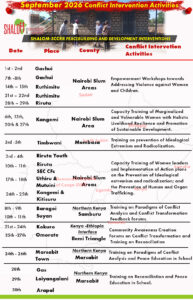
- 1,292 Workshops Trainings on Conflict Transformation-Peacebuilding Techniques in 36 Conflict Zones.
- 38,439 influential opinion shapers trained with Conflict Transformation-Peacebuilding Capacities, transforming Inter-Tribal Conflict and Religious Ideological Extremism (Terrorism).
- 8,096 Women from Urban Informal Settlements (Slums) trained with Conflict Transformation and Peace Building Capacities, addressing Violence against Women and Children (since September 2022).
- 7,195 Women experiencing acute violence living in Slums, supported with Holistic Livelihood Resilience Capacity through 285 training workshops
- (since September 2022).
- 30+ Interethnic and Interreligious School/Development Projects, to date, centered on conflict transformation and peacebuilding are presently being processed, ensuring Non-Sectarian Peaceful Sustainable Development.
By:
Francis Mwangi, M.A, M.E.R.L Officer
Copyright © 2025 Shalom-SCCRR, https://shalomconflictcenter.org/