Rev. Dr. Emmanuel T. Tembo is a Congolese National working in the Conflict Environment.
Introduction
Since its inception in 2009 through the belief, vision, and charisma of Rev. Dr. Patrick Devine, the Shalom Center for Conflict Resolution and Reconciliation (Shalom-SCCRR) invests in reconciliation-oriented programmes at the grassroots level and aims at assisting with conflict resolution and reconciliation processes in Eastern Africa. As far as Eastern Africa is concerned, it should be reminded here that the Democratic Republic of Congo (DRC) is the last member to accede to the East African Community (EAC) Treaty: it was on 8 April 2022. Later on, the DRC became a full member on 11 July 2022.[1] The DRC EAC membership is certainly fortuitous but also enhances the opportunity for Shalom-SCCRR to expand its wings, thereby providing training in conflict transformation skills and peacebuilding techniques to the conflict-ridden DRC. Shalom-SCCRR is making significant strides towards the integration of the DRC in its conflict transformation and peace building programme through the work of one of its consultants, Rev. Dr. Emmanuel Tembo, who since 2022 has been co-facilitating workshops in North Kivu Province, eastern Republic of Congo. This paper is a narrative piece about the conflicts and their causes in the province and about the series of workshops held in Goma and that covered the period between 2022 and 2025. The conclusion will portray a positive impact of the workshops in the sense that despite the resurgence of the M23 rebellion, community facilitators (CFs) and community representatives (CRs) have been trained in peacebuilding and reconciliation techniques. The vision, mission, methodology and capacity of Shalom-SCCRR is needed with urgency.[2]


Dr. Tom Odhiambo, Rev. Dr. Tembo, and Prof. Wanyande, with Rev. Dr. Patrick Devine, during the launch of his recent book on the causes for the persistence of the Pokot-Turkana inter-ethnic conflict in Kenya.
Brief Autopsy of Conflict in Eastern Congo
For nearly three decades, the DRC has been grappling with an unprecedented humanitarian disaster whose causes are rooted in the political history of the Congo characterized by the struggle for power, citizenship and land (Nest, 2006; Turner, 2013). Of all the causes of conflicts, ethnic cleavages take the lead, according to the representatives of communities, who have been participating in the workshops. For indigenous roots and ethnic conflicts in the province have existed since the colonial era (Reyntjens, 2010). On the one hand, the ethnic conflict lies on ancient hatred and the stereotype “us against them.” In this regard, Devine (2025) reminds us that “conflict has a memory that is resilient, robust, trans-generational, and moored in culture. Unfortunately, it is frequently contaminated and distorted with erroneous historical narratives and mendacious reporting. Plus, demonization and hypocrisy, where practiced, have potential calamitous consequences, hindering, even preventing, the evolution of conflict transformation, and peacebuilding progress.” On the other hand, ethnic or interethnic conflict in eastern Congo is exacerbated by the competition for resources (Hart & Mwinyihali, 2000; Tembo, 2014); bad governance illustrated by corruption that has become endemic in the institutions of the country (Minani, 2008; Prunier, 1995; Wrong, 2001); and proliferation of small arms, among others. Today, the regional context is particularly unstable with the resurgence of the M23 rebellion.

Ngangi IDPs camp in Goma (DRC)
All the above scenery generates wars and inter-ethnic conflicts that shake the populations and plunge them into a generalized socio-economic-political crisis. The human cost of these years of conflict is expressed in millions of deaths, displacements and abuses. From this conflict situation, a large number of deplorable attitudes, feelings and acts are born, such as stigmatization, demonization, vengeful actions across ethnic groups, mutual distrust, inflammatory and offensive speeches, killing, rape and other physical and psychological violences that have led several people into exile while others live in IDPs camps.
Peace Processes
A peace process is commonly defined as the diplomatic and political efforts to negotiate a resolution to a conflict, especially a long-standing conflict (Tonge, 2014). The literature on peace processes in the DRC surveyed shows that efforts to bring peace in the DRC include military, diplomatic and political means (Tembo, 2022). Military operations have been undertaken from 1990s to date while diplomatic and political efforts began formerly in 1999 with the Lusaka ceasefire agreement (Autesserre, 2010; International Crisis Group, 2001; Mwesiga & Landsberg, 2003); it went on through Sun City Inter-Congolese Dialogue held in 2003 (Rogier, 2004); the establishment of a Truth and reconciliation commission (Wakenge & Bossaerts, 2006; Winter, 2012), the process of incorporating rebels and local militias into the republican army and police branded as “brassage or mixage” (Hendricks & Musavengana, 2010); and the initiative known as Conférences Internationales pour la Région des Grands Lacs (International Conferences for the Great Lakes Region, CIRGL) that started in March 2003 to support the idea of regional security cooperation (Minani, 2008), just to mention a few. The most recent efforts-interventions are the Doha Peace Agreement and the US-brokered ceasefire agreement. The former is an agreement between the M23, allegedly backed by Rwanda, and the DRC. After the signing of a preliminary declaration of principles on July 19, 2025, both parties agreed to start negotiations and sign a final peace deal in August 2025. The latter was signed by the DRC and Rwanda represented by their respective foreign ministers in June 2025 in Washington, without the M23 rebel group. In the deal, “both countries agreed to work together on a joint security commission, guarantee the safe return of displaced people, and cease support of non-state armed groups.” [3]
Unfortunately, the military operations and all peace talks are perceived as a failure as armed confrontations have increased causing deaths and displacement of peoples. The reasons behind the failure remain the same above-mentioned, that is, poor governance and corruption that have impaired peace processes. Even the Doha and US peace agreements are dormant with no impact on the ground as the M23 and the Congolese government accuse each other of breaching the ceasefire agreement. However, this paper put the blame on the top-down methodology employed by peacemakers in their bid to resolve the conflict in eastern Congo and that ignored the local context and actors at the grassroot level. Based on arguments by Autesserre (2006; 2007; 2014), Wakenke and Bossaerts (2006) and Tembo (2022), this paper argues that the political context of North Kivu certainly needed all the mentioned peace processes but a more and daring contextualised approach would lead to better results. The said approach empirically implies a bottom-up approach with the involvement of local stakeholders; the very approach which the Shalom-SCCRR cherishes in its all undertakings.
Shalom-SCCRR’s Methodology in Congo
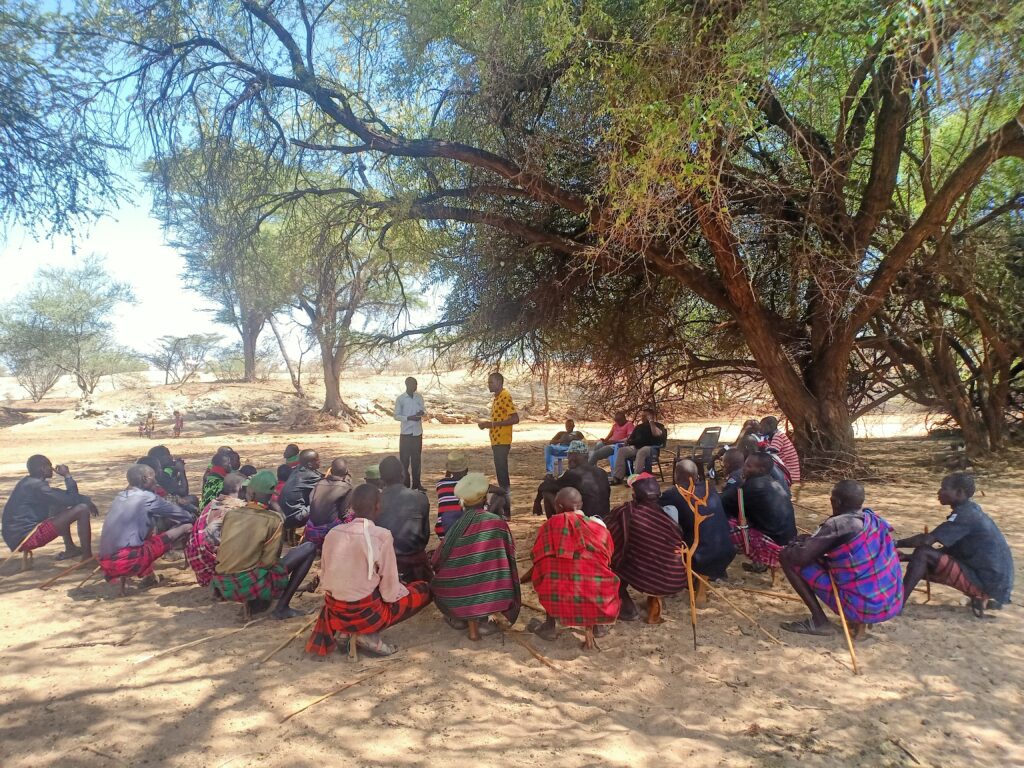
Shalom uses a number of methods in its interventions in the field. The first are the paradigms of conflict whereby participants are broadly instructed about the major causes of conflict from the strategist, peace research and conflict research points of view; the phases and effects of a conflict. In this regard, concrete examples are drawn from participants’ communities and living areas. Put in a nutshell, participants are led through conflict analysis from the incipient phase of a conflict to its transformation. Secondly, the didactics of the training put the participants at the centre of the conversation. Finally, Shalom-SCCRR wishes that the training takes place in people’s sitz-im-leben, I mean in their environment or where cases of violence have been reported. These are some of the techniques that Shalom has been making use of in the volatile environments in Kenya in its bid to quell protracted interethnic conflicts in the instance of those waged between the Pokot and the Turkana (Devine, 2025), the Turkana and the Dassenach in the so-called Ilemi Triangle (Devine, 2025).

Workshop participants sharing conflict experience in Goma (DRC).
The above Shalom methodology has been employed by one of SCCRR international consultants, Rev. Dr. Emmanuel, supported by the Shalom-SCCRR international capacity reservoir,in a series of peace workshops that have taken place since 2022, as stated in the introduction of this paper. The project intervention was the initiative of the Anglican Church of Congo under the leadership of Rt. Rev. Martin Gordon; that, in order to fulfil its peacebuilding mission, partnered with the Catholic Diocese of Goma, the Baptist Community in Central Africa, and the Evangelical Lutheran Church of DRC to organise an Interfaith Project for Peace in North Kivu known in its French version as Projet Interconfessionnel pour la Paix (PIP). Four (4) workshops so far have been conducted, all in Goma city, the capital of North Province. PIP001 was the Pilot Project: it covered the period from June 1 to 3, 2022 and was concerned with the training of religious leaders living in Goma city in peacebuilding mechanisms and strategies. PIP002 held between 1st and 17th June 2023 was an extension of the Pilot Project PIP001; it broadened the spectrum of the latter by including religious, customary and community leaders from the territories of Masisi, Rutshuru, Walikale and Nyiragongo. Its objective was to train 320 religious, customary and community leaders in the prevention, management and transformation of ethnic conflicts, land disputes and in advocacy of human rights, especially child and women rights with a view to consolidating peace in North Kivu. PIP003 (15-16 January 2024) aimed at training 540 people identified as mediators of inter-ethnic conflicts. They would be involved in the prevention, management and peaceful resolution of ethnic, land and social conflicts and contribute to stability and the maintenance of peace. The last in date was the PIP004 held from 13 to 14 January 2025. It ended few days before the M23 rebel group seized the city of Goma. The objective of the two-day workshop was to inform and build the capacity of religious leaders, community leaders, youth leaders, and women representatives of internally displaced persons (IDPs) with regard to conflict transformation, mediation, and reconciliation and intercultural dialogue. Ever since, the extremely volatile situation that prevails in the province of North-Kivu has hindered the necessary intervention.

Photo of workshop participants with Rev. Martin Gordon (middle) and Rev. Dr. Tembo (in maroon outfit), Goma (DRC).
The above-mentioned workshops borrowed heavily from Shalom-SCCRR methodology in several areas. For illustration, participatory and experiential approaches, and cooperative learning took the lion’s share. Facilitators and organisers agreed that the training take place next to the refugee camp; reason being: trainees who are religious, customary and community leaders should taste the humanitarian misery in which their fellow citizens are living in, hence see to it that they fulfil their pledges towards peace in North Kivu. The overall objective of the PIP was to find faith-based solutions and local mechanisms to resolve local conflicts by engaging local religious and community leaders in conflict transformation-peacebuilding dialogue and encouraging them to place the interests of the community above individual ambitions.

Rev. Dr. Tembo engaging with workshop participants, Goma (DRC).
It is worth noting that before and concurrently with the PIP programme, there are numerous peace initiatives led by the international, regional, national and local communities, including peace conferences single-handedly undertaken by churches. The originality of the PIP lies in its integrative setup: churches decide to combine their efforts to train their religious leaders in their attempt to consolidate peace in North Kivu. However, given the collaboration that must exist between leaders at all levels, the programme seeks the training of customary and community leaders as well – key influential opinion shapers. In short, the mentioned leaders (religious, customary and community) are the direct project beneficiaries who should help in the promotion of peace in their respective churches and entities. The indirect beneficiaries include the dependents of the above-mentioned leaders, the participants in cultural activities, the listeners of awareness programmes and the members of religious denominations, all estimated at 262,977.
Conclusion
To a large extent, the intended training objectives were achieved through the capacity-building process of training and interaction with religious and community leaders from Goma and the territories of Masisi, Walikale, Rutshuru, and Nyiragongo. Participants left with appropriate skills in conflict transformation, mediation, reconciliation and intercultural dialogue. The interactions during the training led participants to become aware of the breakdown of their communities in terms of conflict. All in all, the PIP workshops held in Goma for the last three years have been a success, thanks to the leadership of Rev. Dr. Patrick Divine, the international chairman of Shalom-SCCRR who facilitated Rev. Dr. Emmanuel one of his consultants co-facilitate the said workshops. We can affirm that the Shalom-SCCRR ‘Banner’, mindset and spirit is now operational in the volatile environment of DRC through its unique worldwide known methodology that has largely been used in the PIP. Now both Rev. Dr. Patrick and Rev. Dr. Tembo are working tirelessly to make sure an official branch of Shalom-SCCRR is erected in the country.
May I also express my congratulations to Shalom-SCCRR leadership and vision for the recent establishment of the Center for Conflict Transformation and Peace Building (CCTPB) in Tanzania. In my post of social media – LinkedIn – I stated, “The launching of the Center for Conflict Transformation and Peacebuilding (CCTPB) in Tanzania is good news. This demonstrates that Shalom Center for Conflict Resolution and Reconciliation (SCCRR), under the leadership of Rev. Dr. Patrick Devine, pursues its mission and vision to render Africa a peaceful continent, starting from the Eastern Africa Region. I wish the next launch be in the Democratic Republic of Congo (DRC) that became a full member of the EAC on 11 July 2022. Actually, as it is written in the article, “there is an urgent need for conflict transformation and peacebuilding, leading to resolution and reconciliation.” For the reminder, for nearly three decades, the DRC has been grappling with an unprecedented humanitarian disaster whose causes are rooted in the political history of the Congo characterized by the struggle for power, citizenship and land. In addition, bad governance illustrated by corruption has become endemic in the institutions of the country. Moreover, the regional context is particularly unstable with the resurgence of the M23 rebellion. All this scenery generates wars and inter-ethnic conflicts that shake the populations and plunge them into a generalized socio-economic crisis. The human cost of these years of conflict is expressed in millions of deaths, displacements and abuses. From this conflict situation, a large number of deplorable attitudes, feelings and acts are born, such as stigmatization, demonization, vengeful actions across ethnic groups, mutual distrust, inflammatory and offensive speeches, killing, rape and other physical and psychological violences that have led several people into exile while others live in IDPs camps.
SCCRR has started its impact on struggles in the DRC through our humble contribution of animating workshops on conflict transformation since 2023. The last workshop took place in Goma Town in January 2025, one week before the rebels of M23 invaded the place. The said workshops borrowed heavily from SCCRR methodology in several areas: among others, we mention the paradigms of conflict; the didactics of the training that puts the participants at the centre of the conversation and the consideration of people’s sitz-im-leben, where the training takes place. Now the time is ripe for Shalom to have an official branch in the country. Notwithstanding the political upheavals in the conflict-ridden Eastern Congo, the process is underway, thanks to a lot of Rev. Dr. Patrick’s hard work and encouragements.
Author: Rev. Dr. Emmanuel Tembo, Associate Professor
References
Autesserre, S. (2007). D. R. Congo: Explaining peace building failures, 2003-2006. Review of African Political Economy, 34(113), 423-441.
Autesserre, S. (2008). The Trouble with Congo: How local disputes fuel regional violence. Foreign Affairs, 87(3), 94-110.
Autesserre, S. (2010). The Trouble with Congo: Local violence and the failure of international peacebuilding. New York: Cambridge University Press.
Autesserre, S. (October 2014). To solve mass violence, look to locals. Speech on TEDGlobal 2014, Rio de Janeiro, Brazil. Retrieved January 30, 2021, from https://www.ted.com/talks/severine_autesserre_to_solve_mass_violence_look_to_locals/transcript
Devine, P.R. (2025). The Ilemi Triangle Environs: Delineating the Causes and Consequences of the Turkana-Dassenach Conflict. Published by Shalom Center for Conflict Resolution and Reconciliation (Shalom-SCCRR). https://shalomconflictcenter.org/https-shalomconflictcenter-org-congratulations-to-rev-dr-patrick-devine-on-his-recent-publication-from-all-the-shalom-sccrr-team/
Devine, R. P. (2025). Persistent conflict between the Pokot and the Turkana (2nd Edition). Nairobi: Notion Press.
Hart, T., & Mwinyihali, R. (2006). Armed conflict and biodiversity in Sub-Saharan Africa: The case of the Democratic Republic of Congo (DRC). New York: Biodiversity Support Program.
International Crisis Group. (2001). Disarmament in the Congo: Jump-Starting DDRRR to prevent further war. Brussels: ICG.
Kitonga, D. M., Ndiga, B., & Noonan, O. (2025). Contributions of Social Community Structures on Conflict Management among Pastoral Communities in the Ilemi Triangle. Eastern African Journal of Humanities and Social Sciences, 4(1), 68-76. https://doi.org/10.58721/eajhss.v4i1.874
Minani, R. B. (2008). Du pacte de stabilité de Nairobi à l’acte d’engagement de Goma. Enjeux et défis du processus de paix en RDC [From the Nairobi pact of stability to the Goma engagement act: Stakes and challenges of peace process in DRC]. Kinshasa: CEPAS/RODHECIO.
Mwesiga, L. B., & Landsberg, C. (2003). From Cape to Congo: Southern Africa’s evolving security challenges. Johannesburg: International Peace Academy.
Nest, M. (2006). Background to the Congo conflict. In M. Nest, F. Grignon and F. K. Emizet (Eds.), The Democratic Republic of Congo: Economic dimensions of war and peace (pp.17-30). Colorado: International Peace Academy.
Prunier, G. (1995). The Rwandan crisis 1959-1994: History of genocide. Kampala: Fountain Publishers.
Reyntjens, F. (2010). The great African war: Congo and regional geopolitics, 1996-2006. New York: Cambridge University Press.
Tembo, E. T. (2014). The DRC’s endless woes in the hands of vicious black market cartels. East Africa (EA) Mining Review, 1, 6-20.
Tembo, E. T. (2022). Interethnic conflict and the role of traditional leaders in the truth and reconciliation programme in North Kivu, Democratic Republic of Congo. Nairobi: C-Light Interprises.
Tonge, J. (2014). Comparative peace processes. Malden (USA): Polity Press.
Turner, T. (2013). Congo. Cambridge, UK: Polity Press.
Wakenge, R., & Bossaerts, G. (2006). La Commission vérité et réconciliation en RDC: le travail n’a guère commencé [The Truth and reconciliation commission in the DRC: The work has not begun yet]. Kinshasa: Unpublished Report.
Winter, P. E. (2012). A sacred cause: The inter-Congolese dialogue 2000-2003. Strathwhillan, UK: Librario Publishing Ltd.
Wrong, M. (2001). In the footsteps of Mr Kurtz: Living on the brink of disaster in the Congo. London: Fourth Estate.
[1]https://www.eac.int/eac-partner-states/drcongo#:~:text=The%20Democratic%20Republic%20of%20the%20Congo%20acceded%20to%20the%20EAC,member%20on%2011%20July%202022
[2] The SCCRR vision is to build “a society where peace, justice and reconciliation prevail throughout Africa” while its mission aims at “working for a society free of physical violence and unjust social structures in Africa by building peaceful and reconciled communities.” See www.shalomconflictcenter.org
[3] M23-DR Congo peace talks in Doha stalled: What next? | Armed Groups News | Al Jazeera
Relevant Articles
Devine, Patrick R. (2025). Shalom-SCCRR Intervention Methodology, Conflict Management Continuum Diagram and a Brief Rationale Overview (with 16 years Results). https://shalomconflictcenter.org/shalom-sccrr-intervention-methodology-conflict-management-continuum-diagram-and-a-brief-rationale-overview-with-16years-results/
Prof. Wanakayi K. O. (2020, June 24). An Understanding of the Work of Shalom-SCCRR in 2019-2020. https://shalomconflictcenter.org/an-understanding-of-the-work-of-shalom-sccrr-in-2019-2020/
Tembo, E. T. (2023, July 7). Briefing Paper No. 11: Shalom Center For Conflict Resolution and Reconciliation (SCCRR): Voices from The Ground. https://shalomconflictcenter.org/briefing-paper-no-11-shalom-center-for-conflict-resolution-and-reconciliation-sccrr-voices-from-the-ground/
Shalom-SCCRR. (2025, June 4). Shalom-SCCRR 15 Years Results and Achievements. https://shalomconflictcenter.org/shalom-sccrr-15-years-results-and-achievements/
Shalom-SCCRR. (2025, December 27). Launching Forth with Noble Expectations: the ‘Center for Conflict Transformation and Peacebuilding’ (CCTPB) in Tanzania, East Africa. https://shalomconflictcenter.org/launching-forth-with-noble-expectations-the-center-for-conflict-transformation-and-peacebuilding-cctpb-in-tanzania-east-africa/
Moran, M. (2020). Eastern Africa: Shalom-SCCRR receives United Nations (UN) Accreditation. https://shalomconflictcenter.org/3901-2/
Kipkoech, K. & Ndiema, R. (2025, Oct 6). Stewardship at the Shalom Center for Conflict Resolution and Reconciliation (SCCRR). https://shalomconflictcenter.org/stewardship-at-the-shalom-center-for-conflict-resolution-and-reconciliation-sccrr/
Kitonga, D. M., & Noonan, O. (2024). Sustainable Conflict Management in the Ilemi Triangle. Journal of Humanities and Social Science. 29(11), 45-53. https://www.iosrjournals.org/iosr-jhss/papers/Vol.29-Issue11/Ser-3/F2911034553.pdf
Noonan, O., Okoth G., & Kibe, E. (2024). The Intergovernmental Agency for Development (IGAD) and Shalom Center for Conflict Resolution and Reconciliation (SCCRR): MoUs Operationalized in Peace and Development. https://shalomconflictcenter.org/the-intergovernmental-agency-for-development-igad-and-shalom-center-for-conflict-resolution-and-reconciliation-sccrr-mous-operationalized-in-peace-and-development/
IGAD. (2015). IGAD Signs an Updated MoU with Shalom Center.https://igad.int/igad-signs-an-updated-mou-with-shalom-center/
Shalom-SCCRR. (2025, Oct 3). Rev. Dr. Patrick Devine 2025 International Lectures and Presentations. https://shalomconflictcenter.org/rev-dr-patrick-devine-2025-international-lectures-and-presentations/
Butler, J. (Oct, 2023). Harvard Kennedy School; A Conversation with Rev. Dr. Patrick Devine and Paula Soumaya Domit. https://shalomconflictcenter.org/wp-content/uploads/2024/01/Harvard_Kennedy_School_Article_WITH_PHOTOS_MAP_1_17_24_FINAL.pdf
Devine, P.R. (2018). Submission to Public Consultation on the Irish Aid White Paper. https://shalomconflictcenter.org/submission-to-public-consultation-on-the-irish-aid-white-paper/
Devine, P. R. (2025). Conflict and Religion in Eastern Africa: A Conceptual Consideration of Radicalisation, Fundamentalism, Extremism, Terrorism, Tolerance, and Their Interaction Dynamics. https://shalomconflictcenter.org/wp-content/uploads/2025/07/Patrick-Devine-Tangaza-Journal-Conflict-and-Religion-in-Eastern-Africa-Jun-2025.pdf
Okoth, G. & Mwangi, F. (2022). Shalom-SCCRR Facilitates at AMECEA Forum on Addressing Religious Ideological Extremism in Eastern Africa. https://shalomconflictcenter.org/shalom-sccrr-facilitates-amecea-forum-on-addressing-religious-ideological-extremism-in-eastern-africa/
Devine, P. R. (2017). “Radicalization and Extremism in Eastern Africa; Dynamics and Drivers”, published in the Journal of Mediation and Applied Conflict Analysis, 4 (2).http://mural.maynoothuniversity.ie/9086/7/PD-Radicalisation-2017.pdf
Lugonzo, F. (2018). Conflict transformation, Radicalization and Extremism in Eastern Africa. https://shalomconflictcenter.org/conflict-transformation-radicalization-and-extremism-in-eastern-africa/