
By Kennedy Oduor,
“Young people are not merely leaders of tomorrow, but people with immediate needs, such as sustainable peace and development that must be met in the here and now. Shalom-SCCRR’s conflict transformation and peace education across the region encourages the young to become active agents of change in communities. By empowering them with conflict transformation skills and peacebuilding techniques, we cultivate a new generation of leaders who can generate and advocate for reconciliation and sustainable development,” said Rev. Dr. Patrick Devine, International Executive Chairman of Shalom-SCCRR.
According to the World Health Organization [WHO] (2024), it estimates that the prevalence of mental disorders among young people (depression, anxiety, post-traumatic stress disorder, bipolar disorder, and schizophrenia) is at 22·1% (95% UI 18·8–25·7) at any point in time in the conflict-affected populations assessed. In addition to mental disorders, such deeply rooted violence has a profound negative impact in society such as loss of lives, destruction of properties/livelihoods and forceful relocation among others.
From the report, higher magnitude of depression was recorded among students in conflict-affected areas compared to those in non-affected areas. Both pupils and students in learning institutions, more so, girls in such volatile milieu, needed social support and special empowerment programs.
Since 2009, Shalom-SCCRR has been working with vulnerable and marginalized communities that have been affected by cyclical ethnic conflicts in Eastern Africa. To support efforts needed, Shalom-SCCRR initiated School Peace Education programs and established system required to build their capacity in resolving conflict issues without resorting to violence and, to help move the society towards a more peaceful, inclusive and holistic development.
Shalom-SCCRR is engaging with different groups in 36 conflict environments, and young people are a key target groups because of their susceptibility to conflict situations. Apart from being vulnerable targets for recruitment into radical groups and violent extremists, they are also often involved in the execution of violent attacks against opposing groups.

Since (2009), Shalom-SCCRR has established 54 active peace clubs in various selected learning institutions located in conflicts affected areas. These peace clubs are under the resourceful guidance of 103 well-trained peace club patrons.
18,000 peace club members have directly benefited from Shalom-SCCRR training on Conflict Transformation programs and peace building skills/Techniques across Eastern Africa. These have further impacted 165,000 learners through further training and problem solving among the school community.
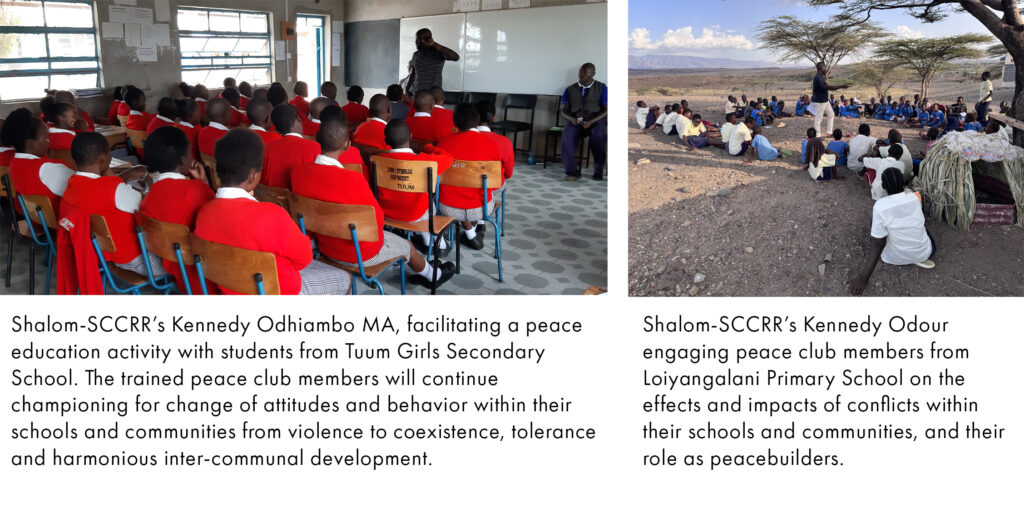
After they have completed the training, they take initiatives to continue with the implementation of peace building activities within the school and in the community. These interventions are ongoing in 36 conflict environments across 11 counties in Kenya and at the Ilemi Triangle, where Kenya, South Sudan, and Ethiopia interface with each other.

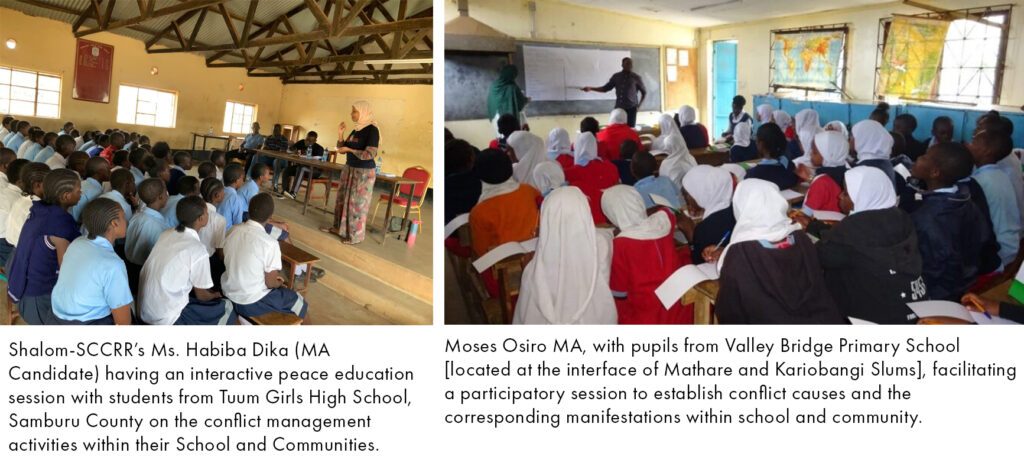
“After attending the training, I realized that conflict starts in the mind of an individual, so it is important to transform the mind first,” Said Elizabeth Akhale, Peace Club member from Marti mixed Secondary School, Samburu County, after attending a two-day training, enabling them to mediate and de-escalate disputes among their peers.

After taking part in several training workshops with Shalom-SCCRR, Mrs. Monica Gumato, peace patron from Loiyangalani primary school, Marsabit said, “The important element I realized was the training methodology and materials were well contextualized to suit our conditions.” We have been guided through the development of an action plan which has focused on how to identify the core underlying causes of conflict in our communities.” She added.
In addition to the peace education efforts, Shalom-SCCRR initiated the Development of infrastructure in learning institutions to provide an environment that motivates the uptake of formal education. 732 School/Educational Development projects have been completed in over 402 learning institutions with over 222,563 pupils and students benefiting from the support.
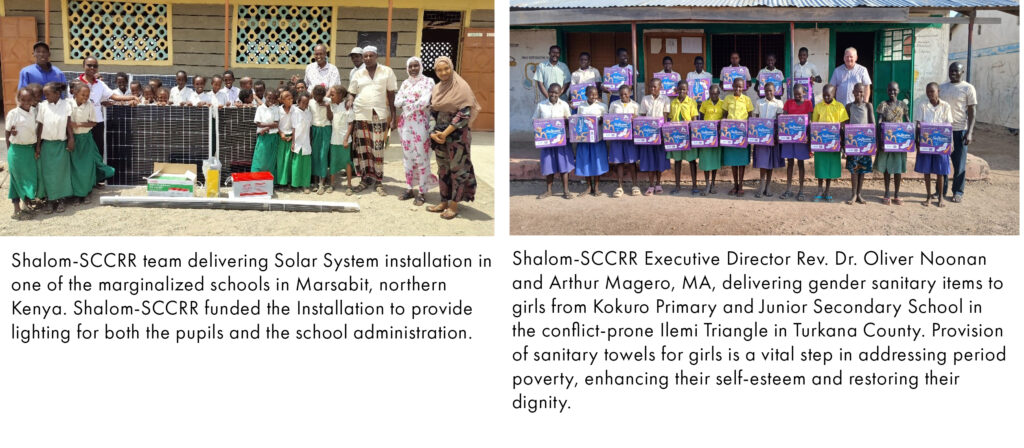
“Shalom-SCCRR’s conflict transformation and peace building interventions empower the emergence of inter-ethnic and inter-religious school/educational development projects. These results, in turn, lead to the stabilization and sustainability of inter-communal peace and development between the former enemies.” Observes Rev. Dr. Patrick Devine.
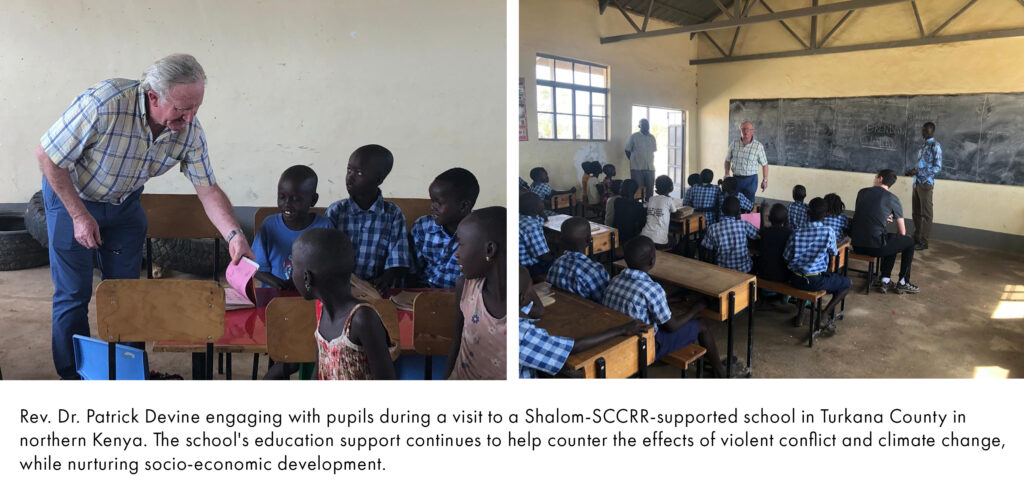
These conflict environments (arid-semi arid and informal settlements in urban areas), where Shalom-SCCRR implements its programs are impoverished, underdeveloped and characterized by persistent structural and manifest inter-ethnic violence. With these realities, the organization has committed itself in strengthening the capacities of communities in conflict, enabling them to be the architects of their own sustainable peace and development.

Using participatory/inclusive learning methods, Peace education programs provide students with the practical skills to identify sources of conflict INTER ETHNIC-CULTURAL-RELIGIOUS, and the expertise to reduce tensions and negotiate peaceful solutions. This has enabled some schools and religious places to incorporate learned lessons into their sessions, explaining the importance of nonviolence, tolerance, mutual respect and reconciliation to thousands of youths drawn from surrounding communities.

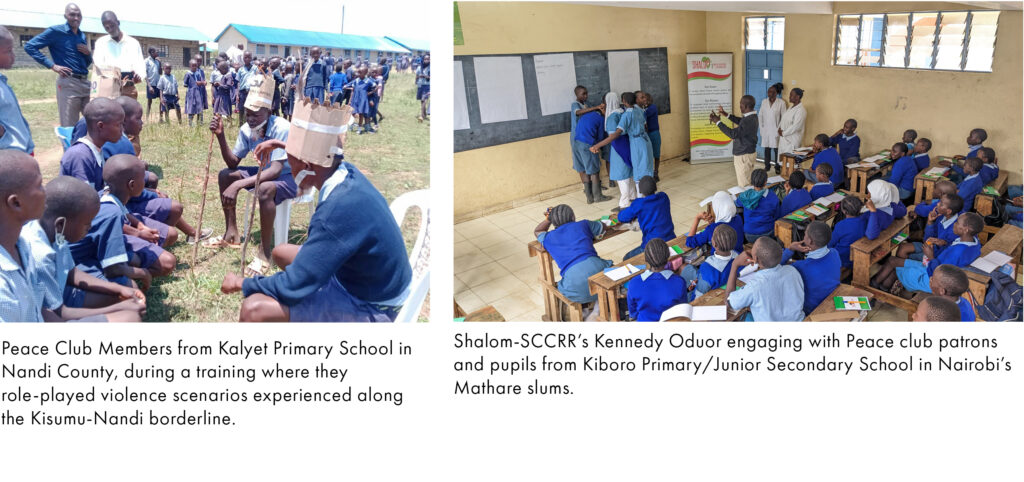
While appreciating the unique approach applied by Shalom-SCCRR, the dedication from the patron and active participation of peace club members, Mr. Paul Macharia, the Principal at St. Peter’s Soba Secondary School – (conflict borderline along Kisumu and Nandi Counties) alluded to the fact that reconciliation between the Luo and the Kalenjin communities is possible. “I believe the possibility that perennial conflicts could soon end, but the transition away from active violence will require our communities especially youths to rethink how they fathom conflict and to learn how to create peace in their communities. For such reconciliation to be possible, it will have to be empowered at the grassroots level.” He added.

We are very grateful to many dedicated generous supporters, staff, volunteers, and participants from conflict environments, whose solidarity and commitment underpin these accomplishments.
Together, we are making an enormous and meaningful direct and long-term difference. Numerous learning institutions in conflict-affected regions in Eastern Africa have benefited from transformative peace-building programs, not forgetting Shalom-SCCRR’s expanded programs to support the development of other key infrastructure (medical, water, lighting) that is enhancing the implementation of peace education methodology and vision.
Overview of Shalom-SCCRR’s Programmatic Outcomes and Impact
By Francis Mwangi MA, Shalom-SCCRR Monitoring, Evaluation, Reporting and Learning (M.E.R.L) Department
Impact of Shalom-SCCRR’s Conflict Transformation and Peacebuilding Interventions
- Increased number of local peace actors and youth are empowered with analytical skills in conflict transformation and peacebuilding.
- Community participation in peace processes at the grassroots level, ensuring local ownership and long-term sustainability of collaborative peace initiatives.
- Reinforced inter-communal economic and social frameworks driven by mutual peace initiatives.
- Strengthened social and cultural inter-ethnic relationships, fostering a conducive local trade, farming, and economic growth environment.
- Increased security for socio-economic infrastructure, including schools (over 90% uninterrupted learning despite conflict), health centers, and markets where Shalom-SCCRR implements peacebuilding projects.
- Schools in conflict-affected and marginalized areas benefited from Shalom-SCCRR educational projects, including new classrooms, sanitation and hygiene facilities, water supply systems, solar lighting, and learning materials. This has improved student seating ratios (from 1 desk per 4-5 learners to 1:1), enhanced student health, and created conducive learning environments.
- Shalom-SCCRR established Peace Clubs with trained patrons and members using the Shalom- Peace Education guide to promote attitudes and behaviors centered on coexistence, tolerance, and peaceful development.
- Increased participation of women (61% in Shalom-SCCRR peace projects) as active negotiators in peace processes at the grassroots level within traditional ethnic communities and urban informal settlements.
- Positive shifts in attitudes, perceptions, and behaviors among rival ethnic communities, fostering trust, collaboration, and shared development in education and livelihoods.
- Strengthened capacity of key local opinion leaders to prevent youth radicalization and ideological extremism (including religious-based extremism).
- Shalom-SCCRR launched a comprehensive anti-human trafficking module, equipping communities with knowledge and skills to identify, prevent, and respond to trafficking, thereby enhancing community resilience and cohesion.
Shalom-SCCRR’s Significant School/Educational Peace & Development Impacts
- Classroom construction and renovation projects have improved pupil enrollment, enhanced learner concentration, boosted teacher morale and fostered a culture of sustainable peace and development owing to the conducive teaching and learning environment.
- Construction of standard toilets and other sanitary facilities has significantly improved the pupil-toilet ratio, which has helped in containing related illnesses.
- The construction of separate toilets for boys and girls has significantly enhanced privacy and safety, particularly for girls, leading to increased school attendance and retention.
- Provision of sanitary items has enhanced girls’ menstrual hygiene management, and contributed to a reduction in school absenteeism thus positively affecting their academic performance and bolstered self-esteem.
- Availability of teaching and learning materials has improved Learner Textbook Ratio, consequently leading to good academic performance for various schools.
- Availability of clean drinking water in schools and communities has significantly prevented waterborne diseases and further improved handwashing and hygiene practices.
- Through the implementation of Shalom Peace Education Syllabus and peacebuilding activities, there is an ever-growing culture of peace in schools and communities, where pupils, teachers and parents have continually embraced coexistence, tolerance and harmonious inter-ethnic schooling and development.
- Operational schools, running uninterrupted (at 90%+) within the conflict environments, have become hubs and symbols of Peace and inter-communal Sustainable Development.
Relevant Links
- Shalom-SCCRR. (2025). School/Educational Development Results and Achievements. https://shalomconflictcenter.org/school-educational-development-results-and-achievements/
- Shalom-SCCRR. (2025, June 4). Shalom-SCCRR 15 Years Results And Achievements. https://shalomconflictcenter.org/shalom-sccrr-15-years-results-and-achievements/
- Devine, P.R. (2025, May 9). Shalom-SCCRR Chairman’s Report for 2024; Rev. Dr. Patrick Devine. https://shalomconflictcenter.org/shalom-sccrr-chairmans-report-for-2024-rev-dr-patrick-devine/
- Shalom-SCCRR. (2024, Nov 24). World Children’s Day 2024. Shalom-SCCRR Transforming Children’s Lives Through Education and Peace-Building. https://shalomconflictcenter.org/transforming-childrens-lives-through-education-and-peace-building/
- Shalom-SCCRR. (2024, Nov 13). Recent Peace Results and Shalom-SCCRR School/Educational Developments Projects. https://shalomconflictcenter.org/shalom-sccrr-school-educational-developments-projects/
- Magero, A. & Mwangi, F. (2024, Feb 22). Shalom-SCCRR School and Educational Institutions Along the Kisumu-Nandi Borderline in Kenya contributed immensely to its Conflict Transformation and Peacebuilding Mediation. https://shalomconflictcenter.org/shalom-sccrr-school-and-educational-institutions-along-the-kisumu-nandi-borderline-in-kenya-contributed-immensely-to-its-conflict-transformation-and-peacebuilding-mediation/
- Magero, A. ( 2024, Aug 9). The Successes of Shalom Conflict Transformation and School Educational Development Transformative Interventions in Molo and Kuresoi Sub-Counties in Nakuru County, Kenya. https://shalomconflictcenter.org/the-successes-of-shalom-conflict-transformation-and-school-educational-development-transformative-interventions-in-molo-and-kuresoi-sub-counties-in-nakuru-county-kenya/
- Akedi, J., Kibe E. & Osiro, M. (2023, May 4). Shalom-SCCRR Peace Education in violent and deprived locations: Interventions within Schools in Kenya’s Urban Informal Settlements (Slums) of Kibera, Mathare, and Kariobangi. https://shalomconflictcenter.org/shalom-sccrr-peace-education-in-violent-and-deprived-locations-interventions-within-schools-in-kenyas-urban-informal-settlements-slums-of-kibera-mathare-and-kariobangi/
- Akedi, J. (2021). Shalom-SCCRR supporting the restoration of learning amidst Covid-19 effects: An account of Nairobi’s informal settlements (Slums). https://shalomconflictcenter.org/shalom-sccrr-supporting-the-restoration-of-learning-amidst-covid-19-effects-an-account-of-nairobis-informal-settlements-slums/
- Awed, A. (2021). The Girl-Child: Shalom-SCCRR Impacting Education & the Lives of Young Girls in Marginalized and Remote Locations in Eastern Africa. https://shalomconflictcenter.org/the-girl-child-shalom-sccrr-impacting-the-lives-of-young-girls-in-marginalized-and-remote-locations-in-eastern-africa/
- Awed, A. & Kibe, E. (2021, July 21). Voices from the Ground: Shalom-SCCRR’s Educational and Development Interventions Promoting Peace among Pastoral Communities in Lorgum Area, Turkana County. https://shalomconflictcenter.org/voices-from-the-ground-shalom-sccrrs-educational-and-development-interventions-promoting-peace-among-pastoral-communities-in-lorgum-area-turkana-county/
- Kibe. E. (2018). Shalom Equips Peace Club Patrons in Nairobi with Peacebuilding Skills. https://shalomconflictcenter.org/shalom-equips-peace-club-patrons-in-nairobi-with-peacebuilding-skills/
- Akedi, J. (2020). Thousands of Children and Families in Nairobi’s Korogocho Slum Benefit from Shalom-SCCRR Transforming Interventions. https://shalomconflictcenter.org/thousands-of-children-and-families-in-nairobis-korogocho-slum-benefit-from-shalom-sccrr-transforming-interventions/
- Awed. A. (2018). Shalom Working Towards a Future for Children Free from Engaging in Conflict.https://shalomconflictcenter.org/shalom-working-towards-a-future-for-children-free-from-engaging-in-conflict/