This article was first published by Globe Banner Staff Reports on Tuesday, October 26, 2026.
By: Globe Banner Staff Reports
The Shalom Center for Conflict Resolution and Reconciliation (Shalom-SCCRR), a Nairobi, Kenya-based peacebuilding organization, says it has established a sister center in Tanzania and is extending its conflict transformation work into eastern Democratic Republic of Congo, according to a 2026 impact report posted on its website.
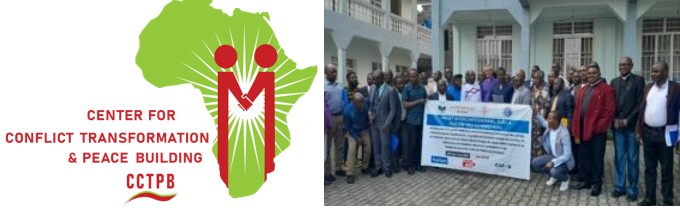
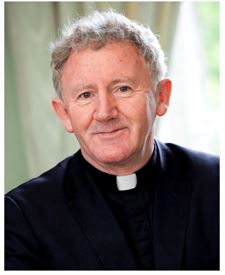
The new Center for Conflict Transformation and Peacebuilding (CCTPB) in Tanzania is “now formally registered and operational,” Rev. Dr. Patrick Devine, Shalom-SCCRR’s executive international chairman and founder, wrote in a foreword included in the report. The center is chaired by Fr. Janusz Machota.
According to Devine, the Tanzanian center “will focus on conflict transformation and peacebuilding, addressing justice, reconciliation, cultural violence – particularly against Women and albinos -, human and organ trafficking, and religious ideological extremism, alongside the needs for vital school and educational development programs.”
“We are grateful to the Government of Tanzania for its trust in us and certification,” Devine wrote.
In Congo, the report says, consultant Rev. Dr. Emmanuel Tembo has led conflict transformation and peacebuilding training workshops in North Kivu Province since 2022, with a series of workshops held in the Goma area through 2025.
“This is Shalom’s vision made real: that no community, however remote or ravaged by violence and disease is beyond the reach of peace, sustainable development, hope, and healing,” Devine wrote.
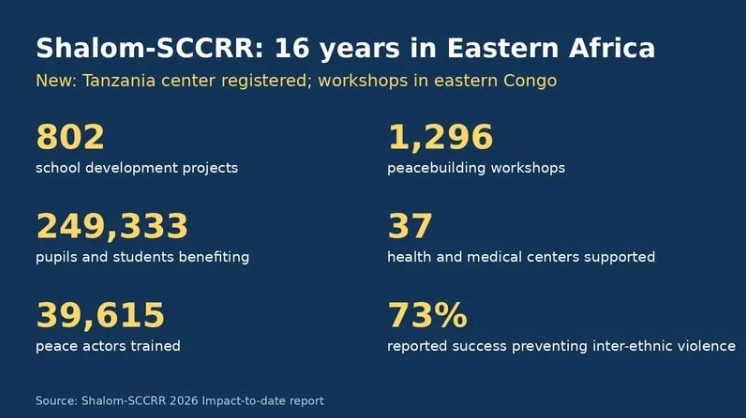
The organization says this year marks 16 years of its work in Eastern Africa. Over that span, according to the report, it has completed 802 school development projects across 452 institutions benefiting 249,333 pupils and students; trained 39,615 “influential peace actors,” including chiefs, elders, religious leaders, women, youth and security personnel, through 1,296 workshops in 36 violent conflict locations; supported 37 health and medical centers in northern Kenya and South Sudan; and established 59 school peace clubs. It also reports training 4,017 women from Nairobi’s informal settlements to prevent human and organ trafficking.
The group says it has achieved “a 73% success rate in Preventing and Mitigating violent inter-ethnic conflicts through locally developed early warning systems.” It also reports that 62% of participants in its 2025 programs were women, up from 2% when the organization was founded. Fuller figures are in the group’s 16-year results summary.
In Kenya’s Kerio Valley, the report says, Shalom-SCCRR has trained 3,652 “key influential opinion-shapers” across four administrative locations, with an estimated impact on more than 300,000 people among the Pokot, Tugen and Marakwet communities.
“Shalom is not a symptom-focused remedy organization. We are dedicated to transforming the underlying causes of conflict and recurring poverty,” Devine wrote.
The group’s 16-year results summary describes its work as covering “the remote Kenya-Uganda-South Sudan-Ethiopia-Somalia border interfaces, Sudan, DRC, Tanzania and remote urban settlements,” and lists “Inter-ethnic conflicts and Religious Ideological Extremism in 36 life-threatening under-developed locations” as the reason. It describes those areas as arid and semi-arid lands marked by competition over grazing land and water, violent livestock raids, and “persistent killing, maiming, displacement and destruction of infrastructure/property.”
“Shalom-SCCRR’s conflict transformation and peacebuilding interventions empower the emergence of inter-ethnic and inter-religious school/educational development projects,” Devine is quoted as saying in the summary. “These results, in turn, enable ongoing conflict transformation leading to the sustainability of peace, development and reconciliation between former enemies.”
The summary also reprints endorsements, including one attributed to Fergal Keane, identified as BBC African editor, who wrote of the group in the Irish Independent: “Kenya needs them in its slums and beleaguered western villages,… what they do here matters to all of Africa.”
In a 2025 synopsis of the group’s methodology, Devine describes Shalom-SCCRR as “an inter-religious non-governmental organization that works in Africa; mainly, in the Eastern Africa member countries of the Intergovernmental Authority on Development (IGAD).” He writes that the group’s entry into a conflict area “begins with being invited and legitimized by stakeholders,” including local chiefs, elders, religious institutions, women and youth, and that the process includes consultation with state security officials. That is followed, he writes, by “rigorous quantitative empirical research on both the causes and persistence of the conflict dynamics.”
Devine and Prof. Peter Wanyande also published a peer-reviewed study this year in the Open Journal of Social Sciences, “Pokot-Turkana Conflict in Kenya: Interrogating Its Causes and Persistence.” Based on Devine’s PhD research, the paper tested three hypotheses: that the conflict persists because its underlying causes have not been addressed, because of ineffective approaches by the state, and because of ineffective activities by the Catholic Church in managing it. The authors write that the Catholic Church “has a pervasive presence throughout the Pokot-Turkana conflict environment and is involved in education, medical care and justice-peace activities, among other spheres.”
The foreword was delivered at charity golf fundraisers for the organization in Ireland and England this year, including events at the K Club and Moor Park Golf Club, according to the report. The group has registered support units in the United States, Northern Ireland and the United Kingdom, and the Republic of Ireland. Devine wrote that donations go “100% to our work in Africa, with 95% of every £1 going directly into our peace, educational, medical, and water development projects on the ground.”
Relevant Links:
- Launching Forth with Noble Expectations: the ‘Center for Conflict Transformation and Peacebuilding’ (CCTPB) in Tanzania, East Africa
https://shalomconflictcenter.org/launching-forth-with-noble-expectations-the-center-for-conflict-transformation-and-peacebuilding-cctpb-in-tanzania-east-africa/ - Democratic Republic of Congo (DRC): Raising the Shalom-SCCRR Banner Amid Its Violent Conflict Eastern Region, By Rev. Dr. Emmanuel T. Tembo.
https://shalomconflictcenter.org/democratic-republic-of-congo-drc-raising-the-shalom-sccrr-banner-amid-its-volatile-conflict-eastern-region/ - Shalom-SCCRR. (2026, September 20). Shalom-SCCRR 2026 Impact-to-date. https://shalomconflictcenter.org/shalom-sccrr-2026-impact-to-date/
- Shalom-SCCRR 16 Years Results and Achievements. https://shalomconflictcenter.org/wp-content/uploads/2026/04/16-Years-Shalom-SCCRR-Results-and-Achievements-LV.pdf
- Devine, Patrick R. (2025). Shalom-SCCRR’s Conflict Transformation and Peacebuilding Intervention Methodology, Processes and Spiritual Rationale (Synopsis) with 16 years Results.https://shalomconflictcenter.org/shalom-sccrr-intervention-methodology-conflict-management-continuum-diagram-and-a-brief-rationale-overview-with-16years-results/
- Devine, P.R. and Wanyande, P. (2026) Pokot-Turkana Conflict in Kenya: Interrogating Its Causes and Persistence. Open Journal of Social Sciences, 14, 180-198. doi: 10.4236/jss.2026.148011
- Devine, R. P. (2025). Persistent conflict between the Pokot and the Turkana (2nd Edition). India: Notion Press. https://www.barnesandnoble.com/w/persistent-conflict-between-the-pokot-and-the-turkana-patrick-r-devine/1147446777
- Shalom Charity Golf Classic 2026 on Tuesday, 26th May at the K-CLUB. https://shalomconflictcenter.org/event/shalom-charity-golf-classic-2026-on-26th-may-at-the-k-club/
- 9TH Annual Fundraiser at Moor Park Golf Course on September 22nd 2026.
https://shalomconflictcenter.org/9th-annual-fundraiser-at-moor-park-golf-course-on-september-22nd-2026/