
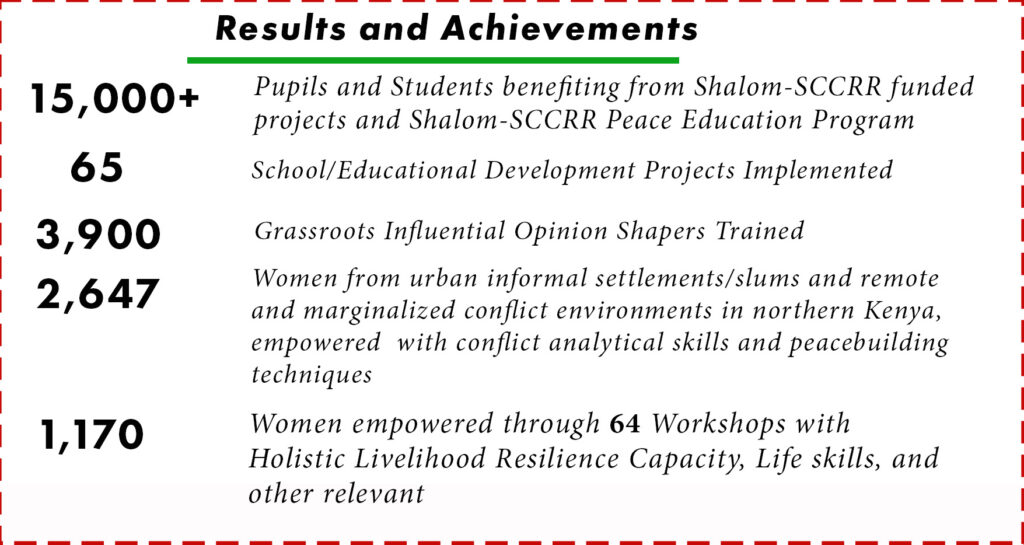
Over the past eight months, Shalom-SCCRR has reached 36 conflict-affected locations through targeted conflict transformation, peacebuilding interventions, and school/educational development projects.
Shalom-SCCRR interventions are implemented in conflict-affected environments where communities have suffered the extreme consequences of inter-ethnic and inter-religious violence, including deaths, maiming, and the displacement of families.
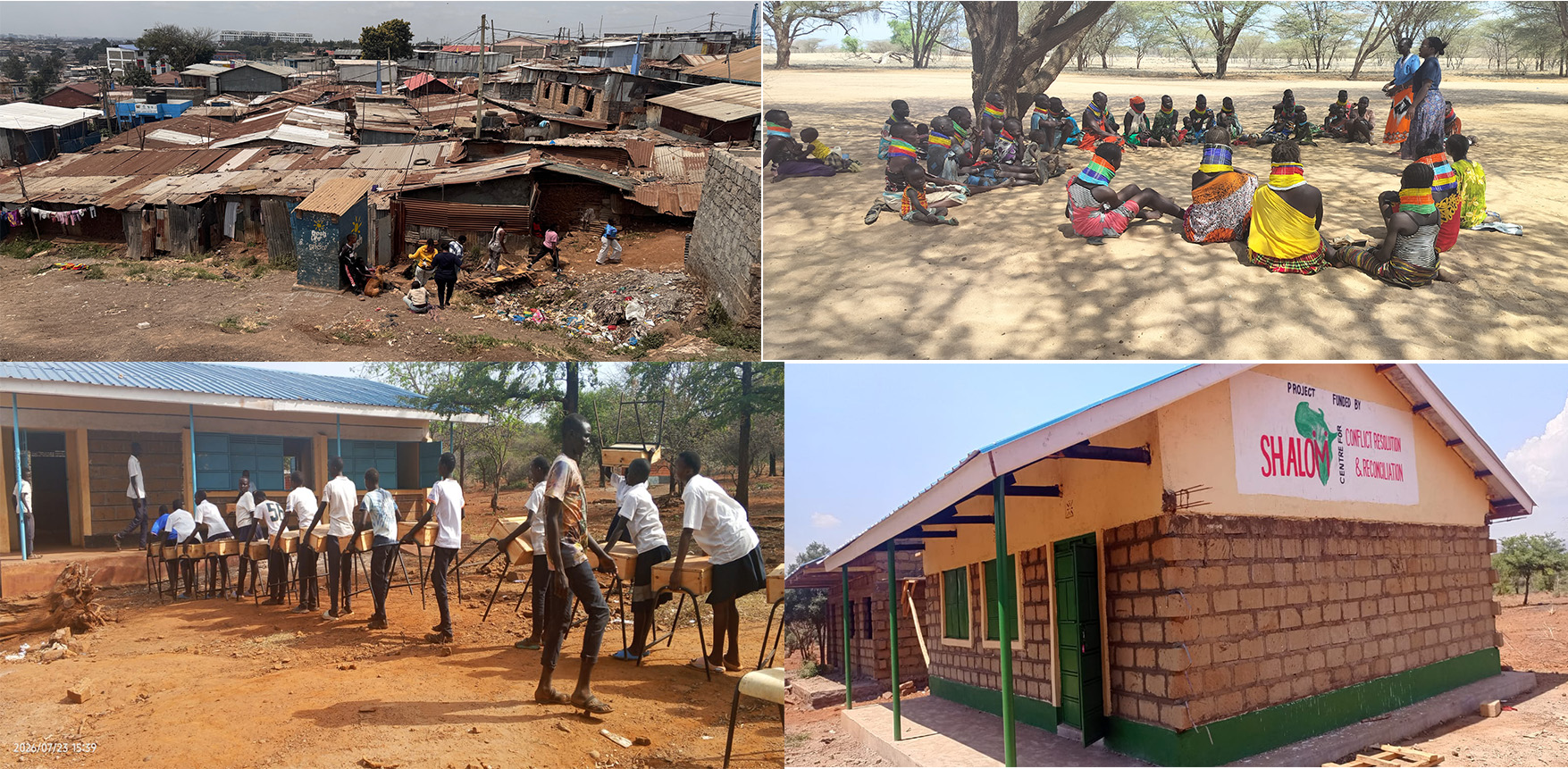
In these locations, Shalom-SCCRR has continued to support schools and community empowerment institutions facing significant infrastructure and resource gaps. These include inadequate classrooms, sanitation and boarding facilities, classroom furniture, textbooks, exercise books, and other essential learning materials.
School/Educational Development Impact


- Classroom construction has replaced makeshift learning spaces, including learning under trees, with safer and more conducive environments for learners.
- Standard latrines have improved sanitation and hygiene conditions and reduced learners’ exposure to sanitation-related illnesses.
- Separate latrines and provision of sanitary items have strengthened menstrual hygiene management, privacy and safety, contributing to reduced absenteeism among girls.
- Textbooks and stationery have improved access to essential learning resources and reduced learner-to-textbook ratios.
- Desks and lockers have improved seating, reduced overcrowding and poor posture, and supported learner concentration and classroom participation.
- Water tanks and supply systems have reduced water scarcity, strengthened hygiene practices and improved access to clean water in Shalom-SCCRR supported schools.
- Solar systems have provided reliable lighting for schools in remote, off-grid and conflict-affected areas, supporting learning and institutional operations.
- Beds, mattresses and other boarding materials have improved accommodation, child protection and continuity of learning.
Peace Education Program Implementation

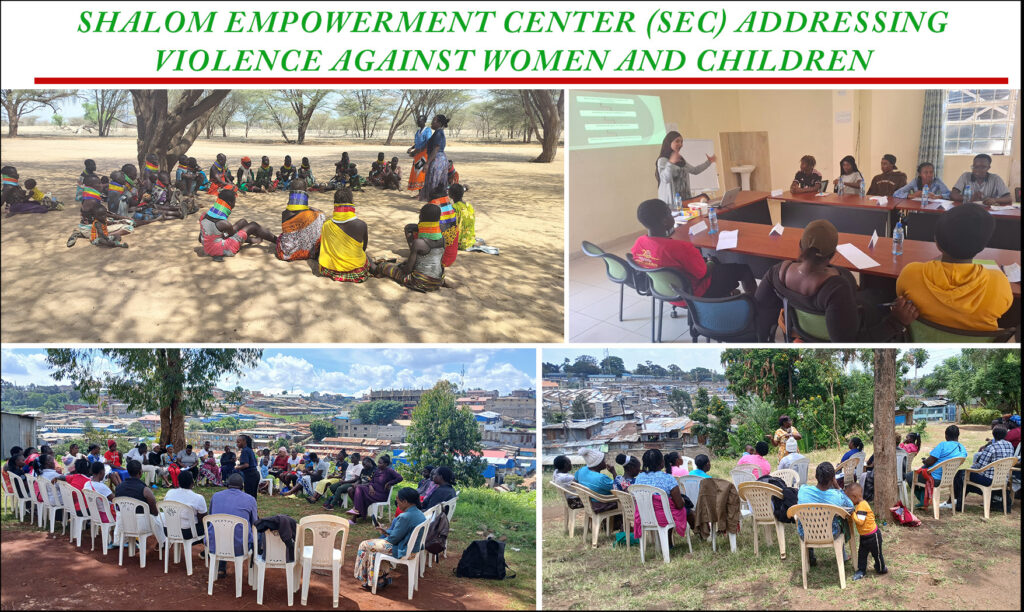
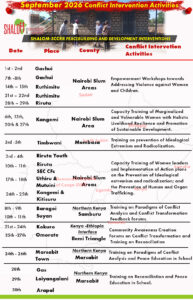
SEC has made a significant contribution to strengthening the capacity, dignity, and resilience of women and vulnerable community members in Nairobi’s informal settlements, slums, and the pastoralist regions of northern Kenya. Through empowerment workshops, SEC has equipped women with practical skills to identify, analyze, and respond to both manifest and structural forms of violence, including domestic violence, sexual violence, inter-ethnic conflict, interreligious tensions, human trafficking, and organ trafficking.
9TH Annual Fundraiser at Moor Park Golf Course on September 22nd, 2026.

2026 Published Articles on Shalom-SCCRR Impact
Pokot-Turkana Conflict in Kenya: Interrogating Its Causes and Persistence by Rev. Dr. Patrick Devine & Prof. Peter Wanyande
https://doi.org/10.4236/jss.2026.148011
This article is an important contribution to conflict and peace research, particularly in understanding the persistence of pastoralist conflict in Northern Kenya. By examining the Pokot–Turkana conflict through empirical research, it moves beyond surface explanations of cattle raiding and resource competition to explore the deeper political, economic, environmental, social, cultural, and structural factors that sustain violence. The work of Rev. Dr. Patrick Devine and Prof. Peter Wanyande is especially valuable because it links rigorous academic analysis with practical implications for conflict transformation, peacebuilding policy, and community-based interventions in pastoralist conflict environments.https://shalomconflictcenter.org/pokot-turkana-conflict-in-kenya-interrogating-its-causes-and-persistence-by-rev-dr-patrick-devine-prof-peter-wanyande/
Transforming Conflict and Building Peace in Northern Kenya: Shalom-SCCRR’s Intervention in the Tuum-Parkati Corridor
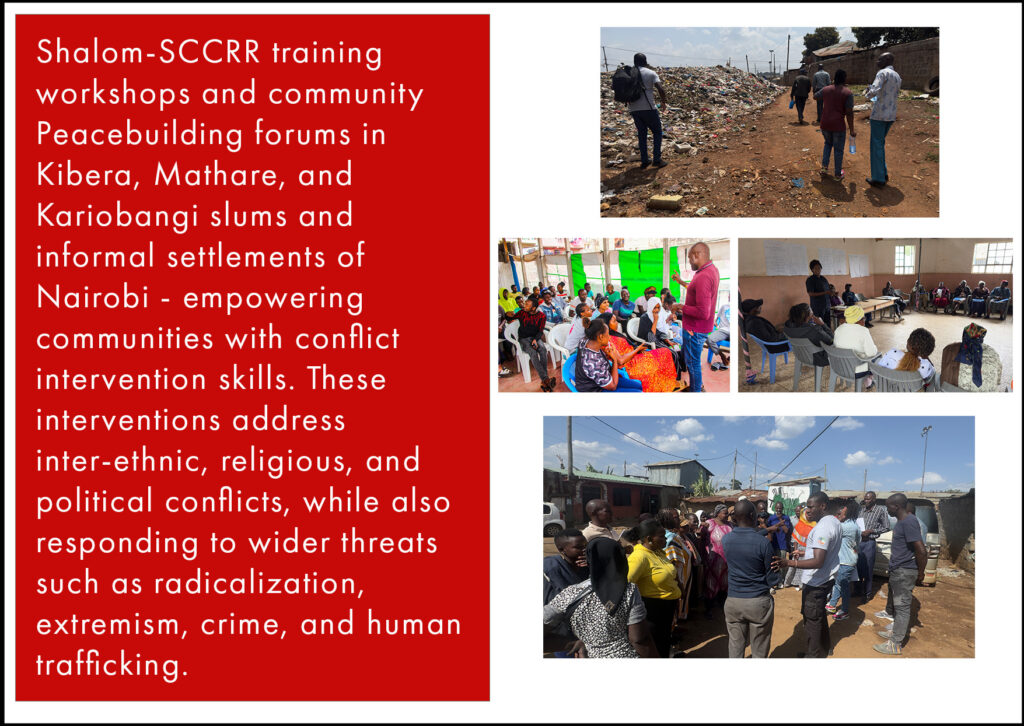
Shalom-SCCRR’s intervention in the Tuum–Parkati Corridor has demonstrated visible impact on the ground by transforming conflict dynamics between the Samburu and Turkana communities. The work has strengthened local peace structures, empowered women and youth as agents of nonviolence, improved inter-community relations, and supported school/educational development initiatives. https://shalomconflictcenter.org/transforming-conflict-and-building-peace-in-northern-kenya-shalom-sccrrs-intervention-in-the-tuum-parkati-corridor/
By: Fr. Jhon Edinson Mena Palacios, & John Kennedy Odhiambo, MA.
Spirit of Life in Kenya’s Slums: Shalom-SCCRR’s Transformative Presence
Shalom-SCCRR’s presence in Nairobi’s slums and informal settlements has strengthened community resilience by walking with vulnerable communities through conflict transformation, peacebuilding programmes, peace education, school and educational development support, and livelihood resilience empowerment.https://shalomconflictcenter.org/spirit-of-life-in-kenyas-slums-shalom-sccrrs-transformative-presence/
By: Mr. Arthur Magero Abonyo MA, Shalom-SCCRR, Project Officer, Ilemi & Elgeyo Marakwet Projects
Ms. Esther Njeri Kibe MA, Shalom-SCCRR, Women’s Lead Project Officer
Rev. Dr. Patrick Devine, Shalom-SCCRR International Chairman
Conflict Transformation-Hope Realized: My Journey with Shalom-SCCRR’s Peacebuilding in Mathare Slum, Nairobi, Kenya
By: Caleb Ngala, in collaboration with Moses Osiro MA
Shalom-SCCRR has empowered local Community Resource Persons in Mathare with practical conflict analysis, transformation, mediation, reconciliation, and community facilitation skills, enabling them to lead grassroots peacebuilding, strengthen social cohesion, and become local agents of hope and positive change. https://shalomconflictcenter.org/conflict-transformation-hope-realized-my-journey-with-shalom-sccrrs-peacebuilding-in-mathare-slum-nairobi-kenya/
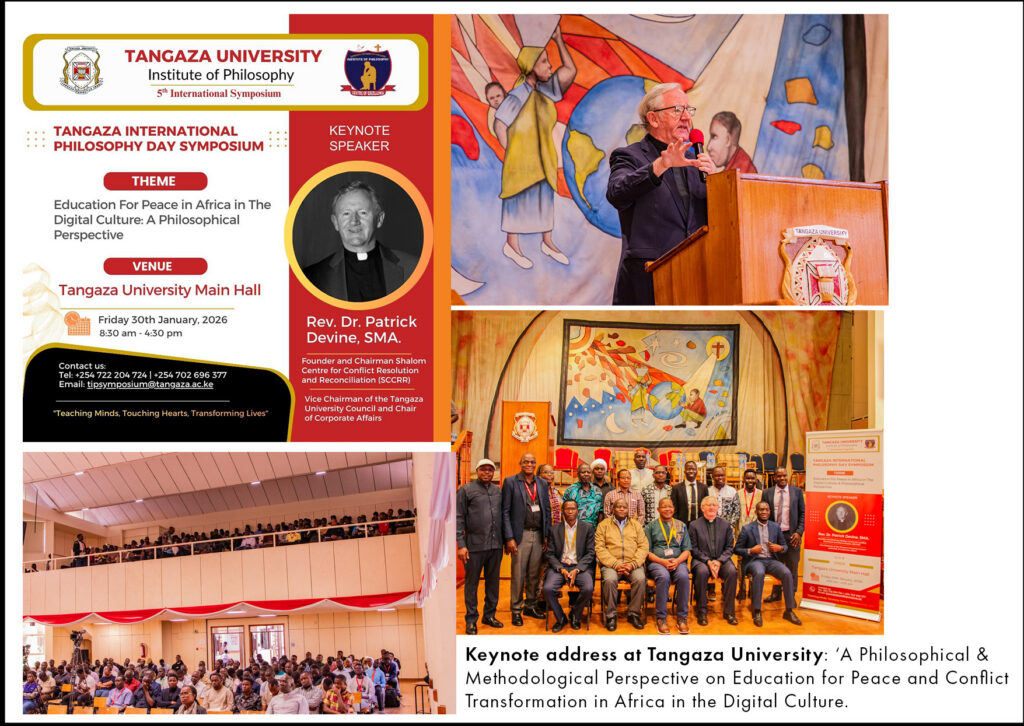
Rev. Dr. Patrick Devine’s Presentation at the Tangaza University, School of Philosophy Symposium
By: Esther Kibe MA
Rev. Dr. Patrick Devine’s contribution to Tangaza University reflects a rare integration of academic leadership, governance, and practical peacebuilding. Through his keynote scholarship, University Council leadership, and support for the proposed MA in Peace, Conflict, and Security Studies, he continues to strengthen Tangaza as a centre for education, reconciliation, and transformative leadership. https://shalomconflictcenter.org/rev-dr-patrick-devines-presentation-at-the-tangaza-university-school-of-philosophy-symposium/
The Nexus Between Logistics in Transportation, Delivery Management, and the Success of Shalom-SCCRR’s Peacebuilding and Educational Development Programs: Reflections from My Experience
By: Kennedy Otieno
Shalom-SCCRR’s work in conflict-affected environments demonstrates the demanding reality of delivering peacebuilding, humanitarian, and school-educational development assistance in remote and high-risk areas. Many of these regions are characterized by intercommunal conflict, resource-based violence, weak infrastructure, limited state presence, harsh climatic conditions, poor communication networks, and insecure routes vulnerable to armed conflict and banditry. In this context, logistics is not simply about transport and delivery; it becomes a critical bridge between vulnerable communities and Shalom-SCCRR’s interventions.https://shalomconflictcenter.org/the-nexus-between-logistics-in-transportation-delivery-management-and-the-success-of-shalom-sccrrs-peacebuilding-and-educational-development-programs-reflections-from-my-experience/
Violent Conflict in Kenya’s Kerio Valley; Shalom-SCCRR’s Conflict Transformation Intervention Gains Momentum
By: Arthur Magero Abonyo MA
Shalom-SCCRR has empowered 3,652 key influential opinion-shapers with analytical skills and practical techniques in conflict transformation and peacebuilding across four administrative locations, with an estimated impact on over 300,000 people along the Kerio Valley.
The trainings have enhanced the capacity of community members to analyze the root causes of conflict, rebuild trust, restore relationships, and develop locally owned solutions for peaceful coexistence among the Pokot, Tugen, and Marakwet communities. https://shalomconflictcenter.org/violent-conflict-in-kenyas-kerio-valley-shalom-sccrrs-conflict-transformation-intervention-gains-momentum/

In 2026, Shalom-SCCRR was honoured to receive some of its Donors
In 2026, we had the privilege of receiving some of our donors, who visited programme areas in the slums and informal settlements of Nairobi, as well as the marginalized conflict environments of arid northern Kenya.
The visit provided them with a firsthand opportunity to interact with diverse community groups and witness the impact of Shalom-SCCRR’s work in conflict transformation, peacebuilding, women empowerment, and school/educational development.


Our sincere appreciation goes to all Shalom-SCCRR donors whose generosity continues to make this work possible. Your support is transforming lives, strengthening resilience, and bringing hope to some of the most vulnerable communities in Eastern Africa.
As conflicts continue to evolve across the region, there remains a strong need to expand these interventions so that more communities can experience peace, stability, and the educational opportunities that every child deserves. For many disadvantaged children, peace is not only the absence of violence; it is the foundation that makes learning, dignity, and a better future possible.
Your support does more than fund interventions; it opens pathways to positive peace, quality education, collective and individual dignity, and a future of hope.
Francis Mwangi, MA, Shalom-SCCRR Monitoring, Evaluation, Reporting, and Learning (M.E.R.L) Department.
Rev. Dr. Oliver Noonan – Shalom-SCCRR Executive Director.
Rev. Dr. Patrick. R. Devine – Shalom-SCCRR International Chairman.
Relevant Links
- Shalom-SCCRR 16 Years Results and Achievements. https://shalomconflictcenter.org/wp-content/uploads/2026/04/16-Years-Shalom-SCCRR-Results-and-Achievements-LV.pdf
- Devine, Patrick R. (2025). Shalom-SCCRR’s Conflict Transformation and Peacebuilding Intervention Methodology, Processes and Spiritual Rationale (Synopsis) with 16 years Results.https://shalomconflictcenter.org/shalom-sccrr-intervention-methodology-conflict-management-continuum-diagram-and-a-brief-rationale-overview-with-16years-results/
- Shalom-SCCRR Chairman’s Report for 2025; Rev. Dr. Patrick Devine with pictures, captions, and links added by the Shalom-SCCRR Communication Department. https://shalomconflictcenter.org/shalom-sccrr-chairmans-report-for-2025-rev-dr-patrick-devine/
- Kipkoech, K. & Ndiema, R. (2025, Oct 6). Stewardship at the Shalom Center for Conflict Resolution and Reconciliation (SCCRR). https://shalomconflictcenter.org/stewardship-at-the-shalom-center-for-conflict-resolution-and-reconciliation-sccrr/
- 2025 School/Educational Development Results and Achievements. https://shalomconflictcenter.org/2025-school-educational-development-results-and-achievements/
- 2025 Conflict Transformation & Peacebuilding Results and Achievements. https://shalomconflictcenter.org/2025-conflict-transformation-peacebuilding-results-and-achievements/
- 2025 Shalom Empowerment Center (SEC) Addressing Violence Against Women and Children Results and Achievements. https://shalomconflictcenter.org/2025-shalom-empowerment-center-sec-addressing-violence-against-women-and-children-results-and-achievements/
- Kibe, E. (2026, June 27). Rev. Dr. Patrick Devine’s Presentation at the Tangaza University, School of Philosophy Symposium.
https://shalomconflictcenter.org/rev-dr-patrick-devines-presentation-at-the-tangaza-university-school-of-philosophy-symposium/ - Devine, P.R. and Wanyande, P. (2026) Pokot-Turkana Conflict in Kenya: Interrogating Its Causes and Persistence. Open Journal of Social Sciences, 14, 180-198. doi: 10.4236/jss.2026.148011
- Kitonga, D. M., Ndiga, B., & Noonan, O. (2025). Contributions of Social Community Structures on Conflict Management among Pastoral Communities in the Ilemi Triangle. Eastern African Journal of Humanities and Social Sciences, 4(1), 68-76. https://doi.org/10.58721/eajhss.v4i1.874
- Devine, R. P. (2026). The Ilemi Triangle Environs: Delineating the Causes and Consequences of the Turkana-Dassenach Conflict (2nd Edition). India: Notion Press. https://notionpress.com/in/read/the-ilemi-triangle-environs-hardcover?srsltid=AfmBOorDxQeYEJjpPnBpCProynUIT0XUHqCRqs4MqlYgGV0KzsS_F9m4
- Devine, R. P. (2025). Persistent conflict between the Pokot and the Turkana (2nd Edition). India: Notion Press. https://www.barnesandnoble.com/w/persistent-conflict-between-the-pokot-and-the-turkana-patrick-r-devine/1147446777
- Abdi, H., Okoth G., & Kibe E. (2025). Transforming Ideological Extremism and Radicalization among Kenyan Communities in the coastal area of Timbwani, Likoni, Mombasa County. https://shalomconflictcenter.org/transforming-ideological-extremism-and-radicalization-among-kenyan-communities-in-the-coastal-area-of-timbwani-likoni-mombasa-county/
- Okoth, G. & Mwangi, F. (2022). Shalom-SCCRR Facilitates at AMECEA Forum on Addressing Religious Ideological Extremism in Eastern Africa. https://shalomconflictcenter.org/shalom-sccrr-facilitates-amecea-forum-on-addressing-religious-ideological-extremism-in-eastern-africa/
- Devine, P. R. (2025). “Conflict and Religion in Eastern Africa: A Conceptual Consideration of Radicalisation, Fundamentalism, Extremism, Terrorism, Tolerance, and Their Interaction Dynamics”, published in the 2025 Tangaza Journal of Theology & Mission (2024/1-2). https://shalomconflictcenter.org/wp-content/uploads/2025/07/Patrick-Devine-Tangaza-Journal-Conflict-and-Religion-in-Eastern-Africa-Jun-2025.pdf