‘A Philosophical & Methodological Perspective on Education for Peace and Conflict Transformation in Africa in the Digital Culture.’
By: Esther Kibe MA,
Earlier this year, Rev. Dr. Patrick Devine (International Chairman of the Shalom Center for Conflict Resolution and Reconciliation – SCCRR) was invited as the keynote speaker at Tangaza University’s School of Philosophy Symposium. He was welcomed by the University’s Vice Chancellor, Rev. Professor Patrick Mwania, who acknowledged Fr. Patrick’s long-standing engagement with the University, which extends over three decades of involvement in its governance, development, and leadership, and his current completion of two terms on the University Council as Vice Chair and Chairman of Corporate Affairs.

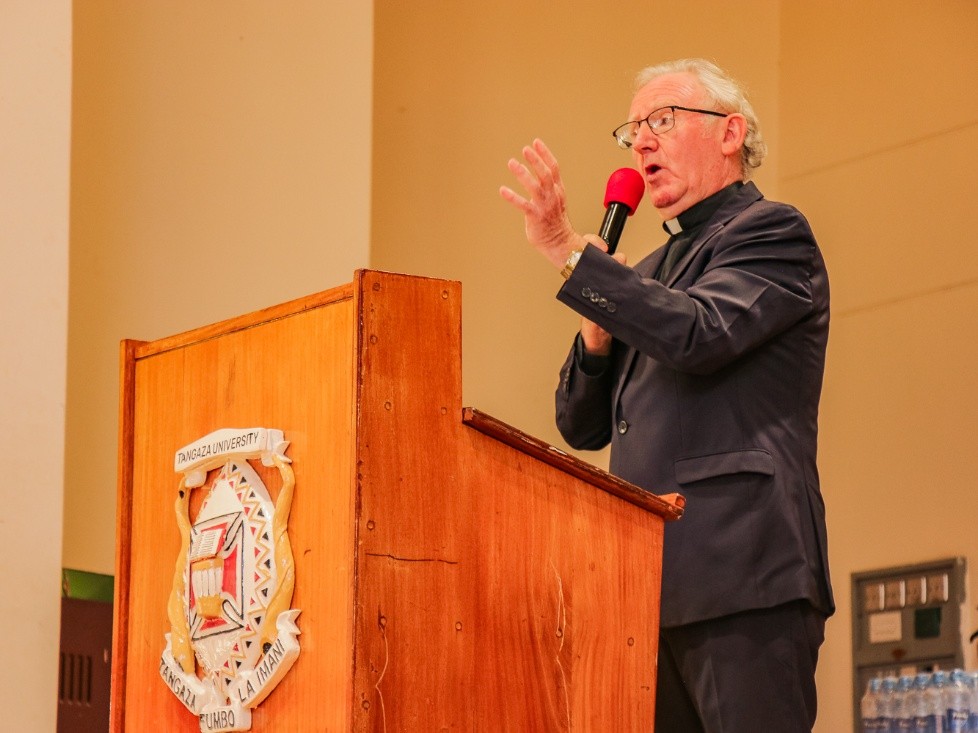
Rev. Prof. Patrick Mwania, Vice Chancellor of Tangaza University and Rev. Dr. Patrick Devine at the commencement of the Symposium
Rev. Dr. Patrick Devine began his address by recognizing the Vice Chancellor’s significant role in the institution’s progress and committed leadership. He stated, “I offer my congratulations to our Vice Chancellor, Rev. Professor Patrick Mwania, for the commitment and quality of his administration here at Tangaza University since his appointment almost three years ago. He continues to make an inspirational and highly significant impact.” Concerning continued engagement and collaboration with Tangaza University, he added that the Vice Chancellor and the Shalom Center for Conflict Resolution and Reconciliation (SCCRR) were endeavoring to jointly complete the process of establishing a Master of Arts in Peace, Conflict, and Security Studies at the University. He noted that Shalom-SCCRR had already developed an initial draft of the MA curriculum, prepared by himself and Professor Peter Wanyande, Shalom’s Director of Research. This draft has been submitted to Professor Mwania for review, and Shalom-SCCRR is awaiting feedback as a necessary part of developing the collaboration substantially. He further observed that this initiative was not a routine academic expansion but a deliberate and necessary response to the realities of manifest conflict and structural marginalization on the African continent. As such, digitalization was positioned as an essential component in strengthening the MA program’s reach, quality, and future relevance. He added that applying digitalization to this Master’s program would be invaluable going forward, as indeed to all components of the course.
The address advanced a key epistemological stance, that knowledge demands both conceptual understanding and practical application: “Theory without practice is empty; practice without theory is blind.” This is not merely abstract philosophy but a guiding operational principle for peace studies. Rev. Dr. Patrick Devine expanded on this, noting also that the four Gospels can be conceptually summarized through the lens of reconciliation—with God, one’s neighbor, oneself, and the wider cosmos (creation/environment).
In this regard, reconciliation is not merely a thematic concept but serves as both the conceptual anchor and the practical objective of education for peace, shaping the interpretation, application, interventions, and evaluation of knowledge in real-world contexts.
On the symposium’s theme, ‘Education for Peace in Africa in the Digital Culture: A Philosophical Perspective’, Rev. Dr. Patrick Devine highlighted that it called for the development of forward-looking philosophies of education that empower African leaders to become agents of peace and responsible digital citizens. He deliberately resisted the narrow geographical and continental framing, stating that, “At Tangaza, we are not just empowering Africans alone. We are much more magnanimous than that outlook; we are not inward-looking but global in academic mindset, quality, and content.”

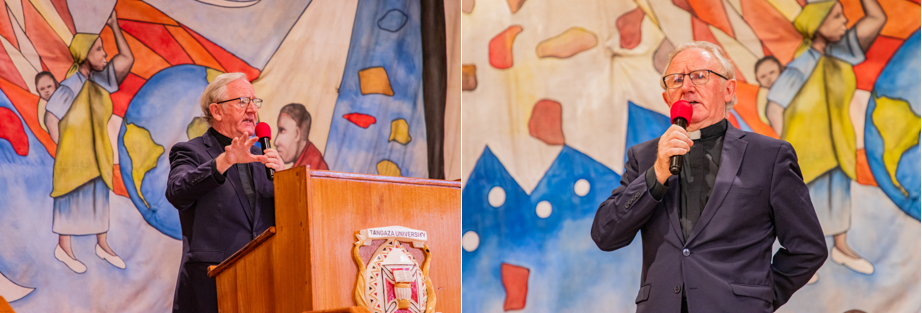
Participants of the Tangaza University School of Philosophy Symposium during the presentation.
He emphasized that Tangaza is a “Proclaimer” university, as reflected in its logo, with a Divine vision and mission to announce the ‘Good News – the Way, the Truth, and the Life’. In addition, he underscored that the university was outward-looking, serving as a hub and powerhouse of inspiration for both academia and practical transformations. The institution he emphasized was intended to be a formative influence in shaping agents for peace, development, and reconciliation. Moreover, he added that the Master’s program mentioned earlier would be instrumental in the crucial task of preventing and transforming conflict, operationalizing peacebuilding, and bringing about reconciliation throughout Africa and beyond.
Digitalization was approached with conceptual precision, calling for clarity and caution. He explicitly demarcated it as “a means to a greater end—a higher purpose,” and not “an end in itself.” Rev. Dr. Patrick Devine stressed that digitalization must be guided by the highest standards of ethics, academic excellence, and respect for human dignity, and must be oriented toward conflict transformation and peace education across the continuum of conflict management from manifest violent conflict to reconciliation. He further explained that peace understood as the mere absence of violence is conceptually limited; this is mere negative peace. The goal of conflict transformation and peacebuilding should always be bringing about positive peace. Whereas negative peace refers to the cessation of killing, maiming, and displacement, the latter denotes a condition in which all sides are mutually committed to each other’s human security, development, and interdependent well-being.
Ethics and authenticity are essential to digitalization, demanding a complete rejection of mediocrity. Upholding these standards requires sustained attention to academic excellence, content quality, philosophical grounding theory, pedagogy, and real-world application. Ethical practice, he underscored, must align with the university’s vision, priorities, processes, people, structures, and mission. In this regard, a strong commitment to ethics and authenticity ensures that technological progress remains rooted in moral and intellectual rigor. Fr. Patrick stressed that institutions such as Tangaza University are therefore expected to uphold the highest standards of academic and ethical integrity in all digital engagements. In passing, he also raised the challenge for Tangaza University administration to urgently ensure that all its academic journals be digitalized!

Some of the symposium participants giving their remarks after Rev. Dr. Patrick Devine’s Keynote Address.
To further ground his philosophical reflections, Rev. Dr. Patrick Devine drew on references to the Synod of Bishops for Africa (2009), Ecclesia in Africa: Reconciliation, Justice and Peace (2011), and related documentation. In 2009, he forwarded a submission to the synod on issues concerning conflict management and peace studies, which has been acknowledged elsewhere as contributing significantly to the content of Proposition 21. He articulated a prophetic conceptual position: the framework of conflict resolution and reconciliation as an inclusive paradigm within which justice, peace, and the integrity of creation must be situated within church governance and educational institutions. He challenged prevailing approaches that separate evangelization from conflict resolution, arguing that such a separation renders it incomplete and ineffective. He underscored that, “To engage in evangelization without competently and practically addressing conflict resolution and reconciliation, both in theory and practice, is inconsistent and contradictory.” This insight reflected his belief in a systems-oriented understanding in which theology, development, and conflict analysis are integrated within a unified paradigm.
He also pointed out that a large part of the African continent remains perennially ensnared in interethnic conflicts among pastoral communities. These conflicts stem from issues such as scarce environmental resources, cultural differences, state neglect, territorial disputes, and the proliferation of small arms. For the Church, therefore, “there is an urgent need for all evangelizers and humanitarian workers to be conscious of, and where possible, help resolve the root causes of conflict. Without the skills and techniques to do so, true peace cannot be achieved.”

He stressed that unless these underlying issues are addressed, neither humanitarian work nor evangelization can adequately fulfill their purpose; lasting peace will remain out of reach. His reflections point to a systems-oriented view of social transformation in which spiritual, social, and structural factors are closely interlinked. Thus, institutions of formation beyond parish structures are needed as educational centers for Conflict Resolution and Peace Studies. This calls for professionally trained individuals—both religious and lay—with the requisite skills to transform conflict into genuine peace and reconciliation.
Rev. Dr. Patrick Devine offered a brief overview of the philosophical rationale for Conflict Transformation, Peacebuilding, and Reconciliation. He explained that these concepts largely arise from his experience since founding the Shalom Center for Conflict Resolution and Reconciliation (SCCRR) in 2009. Shalom-SCCRR is an inter-religious, non-governmental organization (NGO) working in Africa, primarily in the Eastern African member states of the Intergovernmental Authority on Development (IGAD). Furthermore, he highlighted that Shalom-SCCRR’s contributions to Conflict Transformation, Peacebuilding, and Reconciliation are widely acknowledged by multiple ethnic communities, peacebuilding groups, development organizations, universities worldwide, and notable international bodies (UN, IGAD, USA, EU, UK, Vatican–AMECEA). Additionally, the organization delivers lectures in leading educational institutions globally, regionally, and locally, including DePaul University (Chicago), Maynooth University (Ireland), Harvard Law School and the Kennedy School of Government, Fordham and St John’s Universities (New York), Queen’s University Belfast (Northern Ireland, UK), and Tangaza University (Kenya).
The organization’s conflict management scope was presented as encompassing a wide range of conflict domains, including inter-state conflicts, inter-ethnic tensions, issues and processes related to religious and ideological extremism, the empowerment of women to address violence against women and children (born and unborn) in Nairobi’s informal settlements and other major urban slums, governance and electoral conflicts, and the prevention of human and organ trafficking. This breadth reflects an understanding of conflict as multi-dimensional, requiring interventions that are equally comprehensive and context sensitive.
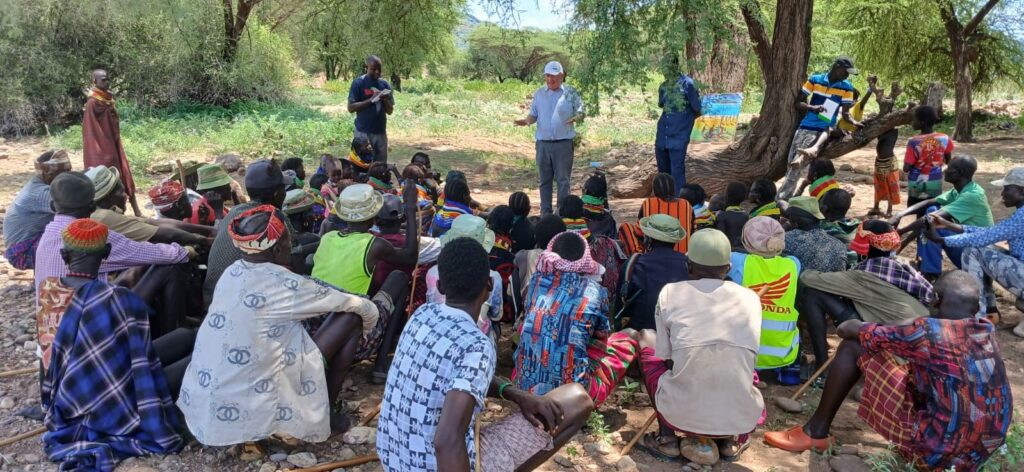
Rev. Dr. Oliver Noonan, Shalom-SCCRR Executive Director and Mr. Arthur Magero MA, Shalom-SCCRR project Officer, engaging local leaders in Kokuro, Turkana County. In 2025, Shalom-SCCRR implemented at least 33 peacebuilding workshops across the Ilemi Triangle at the Kenya–Ethiopia interface, strengthening local leadership and cross-border conflict transformation interventions.
He further reiterated that both theoretical grounding and practical application are inseparable, stating that “Shalom’s work is grounded in the philosophical-methodological perspective that theory without practice is empty and practice without theory is blind.” He also pointed out that the continuum between manifest conflict and reconciliation provides focus and direction for our processes and relevant interventions.

Shalom-SCCRR’s Women’s Project Officer, Ms. Esther Kibe MA, engaging women from Nairobi’s Mathare Slums during a community engagement forum. They deliberated on the different forms of manifest and structural violence women face within slum environments.
A particularly significant contribution of the address lay in its articulation of the humanitarian-peace–development nexus. He stated that, “in African conflict environments where people are killed, maimed, and displaced persistently, essential social and religious values (Gospel values) such as peace, truth, justice, and mercy find it extremely difficult, if not impossible, to take deep communal root; making it difficult for people to live normal lives and experience the Divine Presence.” He reinforced that these fundamental social and religious gospel values are of utmost importance for people in conflict environments who desire peace, development, and reconciliation as they strive to live normal lives as individuals, families, neighbors, and communities, and to experience the Divine Presence.
Reconciliation was defined as a process that acknowledges the past, reframes the present, and envisions a future in which all sides are mutually committed, in freedom, to the dignity of human life, security, development, and the holistic well-being of one another. He expressed optimism that the development of a Master’s program in Peace Studies, International Relations, or Conflict Management at the university, supported by appropriate digitalization processes, would contribute meaningfully to these developments.
The destruction or dysfunction of essential institutions such as schools, hospitals, religious amenities, formation facilities, and other critical infrastructure—which periodically becomes anomalous, inoperable, or non-functional, and at times is destroyed—further compounds this reality, rendering sustained development virtually impossible. This creates a cyclical pattern in which conflict undermines development, and the absence of development, in turn, exacerbates conflict. The rhetorical question posed— “Will societies be forever building, rebuilding, and rehabilitating development institutions, and be morally and ethically indebted, or even legally obliged, to continuously operationalize humanitarian interventions and aid?”—is answered with stark clarity. He warned that such a cycle will persist unless there is a deliberate, committed, and qualified effort, supported by digitalization, to address the underlying causes of conflict through effective conflict transformation and peacebuilding, to end manifest and structural violence, and to achieve sustainable peace in which reconciliation is continuously nurtured.

Mr. Francis Mwangi MA, Shalom-SCCRR Monitoring, Evaluation, Research, and Learning (MERL) Officer, engaging warriors in Arapal, Marsabit County, northern Kenya. In this context, warriors are key actors within inter-ethnic conflict dynamics. Through targeted conflict transformation and peacebuilding training, Shalom-SCCRR is strengthening their constructive participation in locally led peace processes and fostering pathways toward sustainable coexistence.
The address also introduced an additional layer of reflective and analytical depth, with its conceptual contribution lying in the recognition that conflict has a memory—robust, resilient, culturally embedded, and transgenerational. However, this memory is often distorted by erroneous historical narratives, mendacious media reporting, the politicization of religion and the religionization of politics, as well as inept and/or ineffective educational institutions, among other major concerns. This insight aligns with systems-thinking approaches to conflict analysis, in which feedback loops and narrative constructions play a critical role in sustaining cycles of violence.
Rev. Dr. Devine then delved into the integration of spirituality and anthropology for deeper theological reflection, with a particular emphasis on how the ‘Divine Presence’ informs the author’s understanding of peacebuilding. He underscored the incomparable significance of conflict management intervention methodologies, processes, and outcomes, that enable people to live in transformed and stable environments as individuals and communities experiencing the gift of “God’s Spirit and Peace”—the “Divine Presence”—through, with, and within them. The Divine Presence, he affirmed, “empowers us, urges us on, to be the architects of reconciled societies centered on nurturing authentic life-giving relationships with God, our neighbor, oneself and creation—the environment—the cosmos.”
Many of us, if not all, he further affirmed, have, during the course of our lives, had a profound experience of the Divine Presence that has liberated us from being overpowered by the experiences, effects, memories, and knowledge of conflict and war. This experience has compelled us to act, often empowering and enabling us to proclaim and help incarnate the Divine Presence, Mission and Peace throughout the world.
His address did not shy away from a significant and critical reflection. It identifies a pervasive perception among conflict-affected populations that many religious, political, peace, and development actors are either indifferent or ineffective, or engage only in superficial forms of engagement, including rhetorical social-political sentimentality in speeches and publications, as well as educational institutions that promote Peace and Conflict Studies but do little in practice. He observed that some of these actors are “parasites who use the cause to feed themselves, parasitism and hypocrisy are too often the operational phenomena exercised.” This critique directly points to a gap between discourse and practice and, in some cases, to forms of opportunism that exploit the very conditions they claim to address.
This critical stance reinforces Fr. Patrick’s insistence on authenticity, competence, and genuine commitment in peacebuilding work. He observes that “the experience of the ‘Divine Holy Spirit’ endows us with faith, hope, and charity in our daily existence, enabling us to actively bloom where we are planted by authentically caring for all humankind and their environments, and bringing about and realizing peace and reconciliation as we journey toward eternity in the ‘Peace of the Divine Presence’.”
While referencing Psalm 85:10 (Duoay Rheims Version), Fr. Patrick said that, “at the heart of the ‘Divine Presence and Mission’ is the calling to be ‘Agents of Peace and Reconciliation’, operationalized and made tangible through Peace, Truth, Justice, and Mercy“. He maintains that truth underpins the search for justice; injustice must be properly identified and addressed, and ultimately, mercy applied if reconciliation is to emerge. Mercy, he emphasizes, is the ultimate expression of love, evidenced in the recognition of the need to forgive and to be forgiven; “the measure of love is to love without measure” (St. Augustine)—that is, the “Love of the Divine.”

Rev. Dr. Patrick Devine engaging with different participants during the symposium. The symposium was attended by faculty, students and guests from different nationalities.
Quoting the words of Jesus of Nazareth (Luke 19:41, bible.usccb.org) as he shed tears over Jerusalem, “if this day you only knew what makes for peace,” he reinforced the need to understand what makes for peace and reconciliation so that it is not hidden from our eyes. He emphasized the need for us to be filled with the fullness of the “Divine Presence and Mission,” (Ephesians 3;14-19) and for each one of us who has ears to listen attentively. Additionally, with reference to the Lord’s Prayer, he affirmed that the “Divine” is forever reaching out to us so that we may eternally experience the “Hallowedness” of its “Presence, Peace and Mission” in spirit, word, and deed.
He further affirmed that the “Divine” yearns to bless us daily with the wholeness of its “Presence”—the “Bread of Life”—and to unite us with its “Presence, Peace and Mission” in enabling and empowering its “Kingdom Come” and “Will be Done” on earth as it is in heaven. We are therefore called to be missionaries of peace and reconciliation; we are called to become qualified, competent agents of peace. The mission of the Divine is for us to experience its hallowed, loving presence and peace through, with, and within us, which is very fundamental to the “Divine Kingdom” and the “Divine Will.”
He also stated that, “Peace, truth, justice, and mercy stand as pillars of the ‘Divine Parental Love’ for us in relationships as individuals, neighbors, communities, and the creation we are blessed with. We are called to be hallowed as participants in the Divine Presence and Mission of Love.” This framework provides a normative foundation for reconciliation, linking ethical principles with practical action. He observed that, in reference to conflict management, the Church, for example, is frequently criticized as weak or incompetent in conflict theory, limited in technical mastery, with a poor appreciation of history, and lacking a clear, structured policy for engaging with other stakeholders in conflict environments. He asserted that, “Divine Mission to us is ever available, to a) be forgiven our trespasses as we forgive those who trespass against us, b) protect us from falling into any temptation that will separate us from the Divine, and c) deliver us from all evil as we journey to eternal life in the Presence and Peace of the Divine.” As such, digitalization can certainly support this process.

Rev. Dr. Patrick Devine and Ms. Esther Kibe MA, Shalom-SCCRR Women Lead Projects’ Officer during the symposium.
The concluding reflections return to the central theme of integration. The challenge is framed as translating the philosophy of peace education into concrete practice, carried out by proficient and competent agents of peace, while ensuring that this practice remains grounded in sound theoretical foundations. Without this integration, efforts risk becoming directionless and ineffective. The call to action is both collective and individual, urging all present to pursue excellence and to commit themselves in practice to the cause of peace. The closing invocation reinforces the moral and spiritual dimensions of this commitment, situating the pursuit of peace within a broader vision of human and Divine purpose.
The keynote culminated in a clear and direct call to action: individuals and institutions alike were called to become proficient agents of peace, digitalized par excellence in conflict environments. Peace education, he emphasized, had to be translated into practice and grounded in sound theoretical underpinnings; otherwise, it risked becoming directionless and ineffective. The integration of philosophy and practice, theory and application, digitalization and ethics, emerged as the central imperative. He stated, “Practice without academic excellence in respect of the Philosophy of Peace-Theory is blind.” Rev. Dr. Devine also reiterated the need to actively help the Divine Presence, Mission and Peace become incarnate where we live and work.

Vice Chancellor Rev. Prof. Patrick Mwania, Rev. Dr. Patrick Devine, School of Philosophy faculty members, and some presenters posing for a photo after the keynote address.
The concluding reflection was both intellectual and moral, urging all to rise to the challenge of pursuing excellence and committing themselves in practice to the cause of peace. Recalling the discourse of Jesus Christ of Nazareth to Peter when Peter asked about the future of John, “Lord, what about him, Lord?”, Jesus replied, “If it is my will that he stays until I come, what does it matter to you? You are to follow me” (John 21:22, Jerusalem Bible). In doing so, Rev. Dr. Patrick Devine reaffirmed that the pursuit of peace is not optional or abstract, but a concrete responsibility grounded in knowledge, action, and the deeper call to reconciliation.
For the full keynote address: International Philosophy Day Symposium 2026 at Tangaza University. Watch: https://youtu.be/JEotHjDjZj4
The short Bio of Rev. Dr. Patrick Devine as published by Tangaza University for the Symposium (https://tangaza.ac.ke/tangaza-international-philosophy-day-symposium-2026/)

Rev. Dr. Patrick Devine, is a member of the Society of African Missions (SMA), serving as the Regional Superior for Kenya and Tanzania (1995-2007). He was Chairman for the Religious Superiors Conference of Kenya (RSCK), make up of 75 Religious Orders, for two terms and 3 years as Secretary General. He holds a Doctorate in Political Science and Public Administration, a Master’s Degree in Peace Studies and International Relations, and is Certified in Corporate Governance covering concepts, principles and functions. For three decades, he has contributed immensely to the governance, leadership, and development of Tangaza University in Kenya. He also taught at Tangaza for 12 years. Presently, he is the Vice-Chairman of the University Council and Chairman of Corporate Affairs. In 2009, he founded the Shalom Center for Conflict Resolution and Reconciliation (SCCRR), an international organization with its headquarters in Kenya. Shalom-SCCRR has its sustainable peace and development intervention tentacles spread throughout more than 35 conflict environments in eastern Africa (www.shalomconflictcenter. org).
With these qualifications and almost 40 years of experience in Africa, attending to issues of religious and social values, manifest and structural violence, religious ideological extremism, violence against women and children, underdevelopment, and deficits in public administration, he is recognized as one of the foremost authoritative voices on conflict resolution and reconciliation on the continent. In 2013, he was honored with the International Caring Award, succeeding the Dalai Lama, and has since received numerous other local and international accolades, including an IGAD Award (Intergovernmental Authority on Development) for his contribution to justice, peace, environmental, and development interventions. He is a frequent speaker and guest lecturer at conferences and universities around the world, including DePaul, Chicago, Harvard Law School, Kennedy School of Government, Fordham (NY), Queens (UK), and Maynooth (Ireland), among numerous others. He has published numerous rigorously researched articles and books. In the past year and a half, he has published books on the ‘Persistent Conflict between the Pokot and Turkana: Causes and Policy Implications’ and the ‘Ilemi Triangle Environs; Delineating the Causes and Consequences of Tukana-Dassenach Conflict’. Last year, his article on ‘Conflict and Religion in Eastern Africa; A Conceptual Consideration of Radicalization, Fundamentalism, Extremism, Terrorism, Tolerance and their Interaction Dynamics’ was published in the Tangaza Journal of Theology & Mission and has since received global attention through various media outlets.
Interlocutor Response by Dr. Carolyne Buya
Symposium Theme: Education for Peace in the Digital Culture: A Philosophical Perspective
Keynote Speaker: Rev. Dr. Patrick Devine
Venue & Date: Tangaza University, 30 January 2026
“Thank you very much, Rev. Dr. Patrick Devine, for this deeply illuminating keynote. Delivered within the wider conference theme, Education for Peace in the Digital Culture: A Philosophical Perspective, your address has invited us to consider peace not merely as an aspiration or slogan, but as an ethical, spiritual, philosophical, and practical responsibility that must be intentionally lived within our contemporary digital realities.
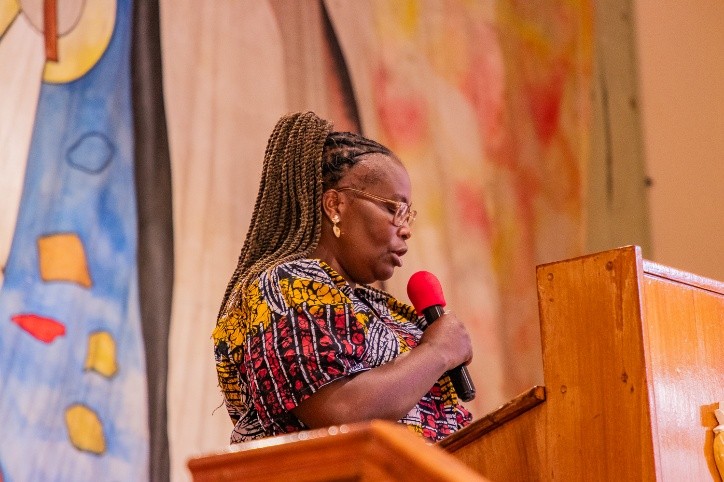
Your opening insight that “theory without practice is empty and practice without theory is blind” offers a powerful interpretive key for the entire presentation. It reminds us that philosophical education must hold together reflection and action, thought and lived experience, concept and reality. In contexts marked by conflict, injustice, and fragile coexistence, philosophy is not a luxury of abstraction; rather, it becomes a central discipline for peace, equipping learners with critical reasoning, ethical discernment, and reflective judgment necessary to engage real conflict situations, whether directly or indirectly. In this sense, peacebuilding is also a moral and intellectual vocation.
A particularly striking emphasis in your keynote is the recognition that “conflict has a memory.” Indeed, conflict does not simply disappear when violence ceases; it persists in narratives, emotions, historical wounds, and today digital archives that preserve and sometimes reactivate past suffering. Your work at the Shalom Center demonstrates that authentic peace requires conflict transformation, not merely conflict management. This means courageously addressing the underlying structural causes of conflict, healing memories, and cultivating relationships capable of sustaining justice. Peace without such depth remains fragile.
Closely connected to this is your rich articulation of reconciliation as a dynamic ethical process which entails acknowledging the past, reframing the present, and working toward an ethical and a just way forward. This vision resonates well with the enduring pillars of reconciliation, that is, truth, justice, and mercy. Truth calls for honest engagement with memory and history; justice demands the rectification of wrongs and transformation of unjust structures; mercy opens the possibility of restoration, forgiveness, and renewed relationship. These pillars provide both a spiritual horizon and a philosophical framework for educating toward peace.
Further, the address reminds us that peace possesses a spiritual dimension that cannot be ignored. In a digital culture often shaped by speed, fragmentation, and performative interaction, the call to authentic divine presence returns us to interiority, conscience, humility, and compassion. Peace, therefore, is not sustained by systems alone but by transformed persons whose ethical commitments are spiritually grounded. Without this depth, even the most sophisticated digital or institutional initiatives risk becoming hollow.
Your distinction between negative and positive peace is equally informative. Many times, individuals and institutions settle for negative peace he mere absence of violence, while neglecting the harder work of building positive peace, characterized by justice, dignity, right relationship, and social flourishing. Education, especially philosophical and theological education, must therefore form persons capable not only of ending conflict but of constructing humane and just communities.
Within the context of digital culture, your balanced insight is especially valuable. Digitalization undeniably expands the possibilities of communication and connection, yet it must ultimately be oriented toward service. When digital spaces cease to serve truth, dignity, and reconciliation, they risk amplifying division, manipulation, and dehumanization. Education for peace must therefore include ethical digital formation which entails cultivating responsibility, discernment, and service-oriented engagement in technologically mediated life.
Your call for Tangaza University to exercise leadership in educating for peace both in theory and in practice is therefore timely and very forward looking. With the roots it has in philosophy, theology, ethics, and social engagement, Tangaza is better positioned to embody the integration you have described: theory with practice, reflection with action, spirituality with justice, and digital engagement with moral responsibility. Such leadership requires not only teaching about peace, but living reconciliation institutionally through curricula, research, community engagement, and digital witness shaped by truth, justice, mercy, and service.
In closing, I pose the following questions to guide our continued reflection:
- How can philosophical and spiritual education better prepare learners for authentic conflict transformation in digitally mediated societies?
- In what ways might digital culture be reclaimed as a space of service, truth, and reconciliation?
- How can institutions such as Tangaza concretely embody positive peace that is anchored in truth, justice, mercy, and divine presence?
Rev. Dr. Devine, your keynote address reminds us that education for peace in the digital age demands philosophical clarity, spiritual depth, ethical courage, and practical commitment. It calls us to memory that heals, justice that transforms, mercy that restores, and digital engagement that serves human dignity.
For this challenge and this hope, we are deeply grateful. Thank you“, Dr. Carolyne Buya.
Author: Ms. Esther Kibe MA, Shalom-SCCRR Communications Department.
Relevant Links:
- Tangaza (2026). Tangaza International Philosophy Day Symposium 2026. https://tangaza.ac.ke/tangaza-international-philosophy-day-symposium-2026/
- Shalom-SCCRR. (2026, Jan 28). Tangaza University (TU) Vice Chancellor, Rev. Prof. Patrick Mwania visits Shalom Center for Conflict Resolution and Reconciliation (Shalom-SCCRR). https://shalomconflictcenter.org/tangaza-university-tu-vice-chancellor-rev-prof-patrick-mwania-visits-shalom-center-for-conflict-resolution-and-reconciliation-shalom-sccrr/
- Shalom-SCCRR (2026, Jan 23). Tangaza University and the Shalom Center for Conflict Resolution and Reconciliation (SCCRR) Ongoing Collaboration. https://shalomconflictcenter.org/event/tangaza-university-and-the-shalom-center-for-conflict-resolution-and-reconciliation-sccrr-ongoing-collaboration/
- Devine, Patrick R. (2025). Shalom-SCCRR’s Conflict Transformation and Peacebuilding Intervention Methodology, Processes and Spiritual Rationale (Synopsis) with 16 years Results. https://shalomconflictcenter.org/shalom-sccrr-intervention-methodology-conflict-management-continuum-diagram-and-a-brief-rationale-overview-with-16years-results/
- International Philosophy Day Symposium 2026 at Tangaza University. Watch:https://youtu.be/JEotHjDjZj4
- Rev. Dr. Patrick Devine; Shalom-SCCRR Chairman’s Report for 2025. https://shalomconflictcenter.org/rev-dr-patrick-devine-shalom-sccrr-chairmans-report-for-2025/
- Shalom-SCCRR Chairman’s Report for 2025; Rev. Dr. Patrick Devine with pictures, captions, and links added by the Shalom-SCCRR Communication Department. https://shalomconflictcenter.org/shalom-sccrr-chairmans-report-for-2025-rev-dr-patrick-devine/
- Butler, J. (Oct, 2023). Harvard Kennedy School; A Conversation with Rev. Dr. Patrick Devine and Paula Soumaya Domit. https://shalomconflictcenter.org/wp-content/uploads/2024/01/Harvard_Kennedy_School_Article_WITH_PHOTOS_MAP_1_17_24_FINAL.pdf
- Shalom-SCCRR. (2025, Oct 3). Rev. Dr. Patrick Devine 2025 International Lectures and Presentations. https://shalomconflictcenter.org/rev-dr-patrick-devine-2025-international-lectures-and-presentations/
- John Kennedy (2026, June 18). Some of the Global Recognition of Shalom-SCCRR’s Conflict Transformation-Peacebuilding Approach. https://shalomconflictcenter.org/the-global-recognition-of-shalom-sccrrs-conflict-transformation-peacebuilding-approach/
- Shalom-SCCRR (2025, April 7). Fordham University, New York; Lecture by Rev. Dr. Patrick Devine, Shalom-SCCRR International Chairman. https://shalomconflictcenter.org/fordham-university-new-york-lecture-by-rev-dr-patrick-devine-shalom-sccrr-international-chairman/
- Shalom-SCCRR. (2025, March 13). St. John’s University, Queens, New York; Lecture by Rev. Dr. Patrick Devine, Shalom-SCCRR International Chairman. https://shalomconflictcenter.org/st-johns-university-queens-new-york-lecture-by-rev-dr-patrick-devine-shalom-sccrr-international-chairman/
- Devine Patrick, R. (2019, May 10). Submission to Public Consultation on the Irish Aid White Paper. https://shalomconflictcenter.org/submission-to-public-consultation-on-the-irish-aid-white-paper/
- An article from the Mirror Newspaper quoting Fr. David Adiletta, the new Chairman of Religious Superiors Conference of Kenya (RSCK).https://shalomconflictcenter.org/wp-content/uploads/2023/08/RSCK-ARTICLE-2010-12-20.pdf
- Kitonga, D. M., & Noonan, O. (2024). Sustainable Conflict Management in the Ilemi Triangle. Journal of Humanities and Social Science. 29(11), 45-53. https://www.iosrjournals.org/iosr-jhss/papers/Vol.29-Issue11/Ser-3/F2911034553.pdf
- Devine, R. P. (2026). The Ilemi Triangle Environs: Delineating the Causes and Consequences of the Turkana-Dassenach Conflict (2nd Edition). India: Notion Press. https://notionpress.com/in/read/the-ilemi-triangle-environs-hardcover?srsltid=AfmBOorDxQeYEJjpPnBpCProynUIT0XUHqCRqs4MqlYgGV0KzsS_F9m4
- Devine, R. P. (2025). Persistent conflict between the Pokot and the Turkana (2nd Edition). India: Notion Press. https://www.barnesandnoble.com/w/persistent-conflict-between-the-pokot-and-the-turkana-patrick-r-devine/1147446777
- Tangaza University. (2024). The VC’s Newsletter Vol. 14. https://shalomconflictcenter.org/wp-content/uploads/2024/12/The-inaugural-Graduation-Ceremony-of-Tangaza-University-The-VCs-Newsletter-Vol.-14.pdf
- Kitonga, D. M., Ndiga, B., & Noonan, O. (2025). Contributions of Social Community Structures on Conflict Management among Pastoral Communities in the Ilemi Triangle. Eastern African Journal of Humanities and Social Sciences, 4(1), 68-76. https://doi.org/10.58721/eajhss.v4i1.874
- Moran, M. (2025, Jan 6). Irish Missionary plays leading role in Tangaza University, Kenya. https://shalomconflictcenter.org/irish-missionary-plays-leading-role-in-tangaza-university-kenya/
- Akedi, J. (2021). A report on the signing of an MoU between Shalom-SCCRR and Tangaza University College. https://shalomconflictcenter.org/a-report-on-the-signing-of-an-mou-between-shalom-sccrr-and-tangaza-university-college-by-ms-judith-akedi-ma/
- Shalom-SCCRR. (2020, Oct 8). Shalom-SCCRR signs MoUs with The Senator George J. Mitchell Institute Queen’s University, Belfast, & Edward M. Kennedy Institute, Maynooth University by Prof. Wanakayi K. Omoka (RIP). https://shalomconflictcenter.org/shalom-sccrr-collaborates-with-the-queens-university-of-belfast-edward-m-kennedy-institute-for-conflict-intervention/
- Kibe, E. (2024). Inaugural Graduation Ceremony of Tangaza University; Rev. Dr. Patrick Devine’s Immense Contribution to the Institution’s Development Applauded. https://shalomconflictcenter.org/inaugural-graduation-ceremony-of-tangaza-university-rev-dr-patrick-devines-immense-contribution-to-the-institutions-development-applauded/
- Devine, P. R. (2025). Conflict and Religion in Eastern Africa: A Conceptual Consideration of Radicalisation, Fundamentalism, Extremism, Terrorism, Tolerance, and Their Interaction Dynamics. https://shalomconflictcenter.org/wp-content/uploads/2025/07/Patrick-Devine-Tangaza-Journal-Conflict-and-Religion-in-Eastern-Africa-Jun-2025.pdf
- Okoth, G., Abonyo, A. & Kibe, E. (2024). Shalom-SCCRR Congratulates Tangaza University for being awarded its University Charter.https://shalomconflictcenter.org/shalom-sccrr-congratulates-tangaza-university-for-being-awarded-its-university-charter/
- Shalom-SCCRR (2022), Tangaza University College, Kenya: Shalom-SCCRR Course – Teaching Minds, Touching Hearts, and Transforming Lives. https://shalomconflictcenter.org/tangaza-university-college-kenya-shalom-sccrr-course-teaching-minds-touching-hearts-and-transforming-lives/
- Moran, M. (2023). Kenya: Fr Patrick Devine elected Vice Chairman of Tangaza University Council. https://shalomconflictcenter.org/kenya-fr-patrick-devine-elected-vice-chairman-of-tangaza-university-council/
- Shalom-SCCRR. (2021). Teaching Minds, Touching Hearts, Transforming Lives at Tangaza University, Kenya: Shalom-SCCRR Course. https://shalomconflictcenter.org/teaching-minds-touching-hearts-transforming-lives-at-tangaza-university-kenya-shalom-sccrr/
- Shalom-SCCRR. (2018). Tangaza University College Recommends Shalom (SCCRR) For United Nations Accreditation. https://shalomconflictcenter.org/tangaza-university-college-recommends-shalom-sccrr-for-united-nations-accreditation/
- Shalom-SCCRR Brochure. https://shalomconflictcenter.org/wp-content/uploads/2026/01/Shalom-SCCRR-Brochure-2025.pdf