
By: John Kennedy Odhiambo MA,
Rev. Dr. Patrick Devine, the International Chairman and founder of Shalom Center for Conflict Resolution and Reconciliation (Shalom-SCCRR), continues to emerge as one of the most influential voices in grassroots peacebuilding, conflict transformation, and humanitarian diplomacy across Eastern and Central Africa. Through decades of committed service among marginalized, remote, and conflict-affected communities, he has successfully elevated locally grounded conflict transformation, peacebuilding and sustainable development approaches into respected global policy and diplomatic spaces. His academic and practitioner expertise is second to none.
His recent participation in strategic engagements in the USA including visits to the United Nations headquarters in New York marks yet another significant milestone in the growing international recognition of Shalom-SCCRR’s transformative work. During his visit also, the Shalom-SCCRR International Chairman was invited by the Permanent Observer Mission of the Holy See to the United Nations to attend the farewell ceremony of His Excellency Archbishop Gabriele Caccia at the conclusion of his diplomatic mission. Archbishop Caccia is taking up a new appointment by Pope Leo XIV as the Apostolic Nuncio to the United States.

Shalom-SCCRR International Chairman, Rev. Dr. Patrick Devine, accompanied by his Excellency Fergal Mythen, Irish Ambassador to the UN, who recently had represented Ireland on the Security Council.
A particularly symbolic moment during the visit was the presentation of Rev. Dr. Patrick Devine’s acclaimed publication, Persistent Conflict Between the Pokot and the Turkana: Causes and Policy Implications to a former member of the Security Council, His Excellency, the Irish Ambassador to the UN, Fergal Mythen. The book represents years of rigorous field research and practical peacebuilding engagement among pastoralist communities affected by cycle of violence in Northern Kenya and neighboring regions. By bringing this publication into global diplomatic spaces, Rev. Dr. Patrick Devine underscored the importance of integrating local realities, indigenous knowledge, and community voices into international peace and security discourse.

Rev. Dr. Patrick Devine, International Chairman of Shalom-SCCRR, was an invited guest of the Permanent Observer Mission of the Holy See to the UN in bidding farewell to Archbishop Gabriele Caccia at the conclusion of his mission to the United Nations and following his appointment as Apostolic Nuncio to the United States by Pope Leo XIV. Fr. Patrick presented him an overview of Shalom-SCCRR’s work and a recent copy of his book; “Persistent Conflict between the Pokot and the Turkana: Causes and Policy Implication.”
During his numerous engagements in the USA and the United Nations, the Shalom-SCCRR Chairman shared the organization’s globally recognized intervention model, rooted in empirical research, evidence-based programming, adaptive Monitoring, Evaluation and Learning (MEL) systems, and community-centered conflict transformation frameworks. These methodologies have become increasingly respected internationally for their ability to bridge the divide between policy-level engagement and grassroots realities. Some of the Schools where the international chairman has lectured include; University of San Diego, DePaul University Chicago, Harvard Law and Kennedy School, Fordham University, St. John’s University, and University of Texas, Austin.
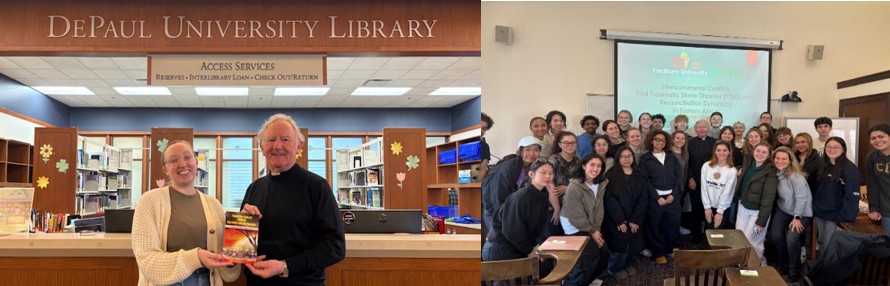
Recently published books, ‘Persistent Conflict Between the Pokot and Turkana: Causes and Policy Implications’ and ‘The Ilemi Triangle Environs: Delineating the Causes and Consequences of the Turkana-Dassenach Conflict,’ presented to De Paul University Chicago as well as at a recent lecture in Fordham University in New York.
These high-level engagements reflect also the ongoing global relevance of Shalom-SCCRR’s distinctive grassroots methodology in addressing some of the world’s most complex and protracted conflicts. The interaction symbolized an important convergence between faith-based diplomacy, humanitarian action, and evidence-driven conflict transformation and peacebuilding practice. It is this unique approach that led to the recognition of the international chairman some years ago by the caring institute chaired by Robert J. Dole who was the former Senator from Kansas, former senate majority leader and U.S republican presidential nominee in 1996 and Thomas Daschle as the Honorary Co-chair who was the former senator for Dakota and U.S senate majority leader. As Shalom-SCCRR team, we are happy for this recognition and the worthy congratulation he received from the President of Ireland Michael D. Higgins upon receiving of the international caring award.
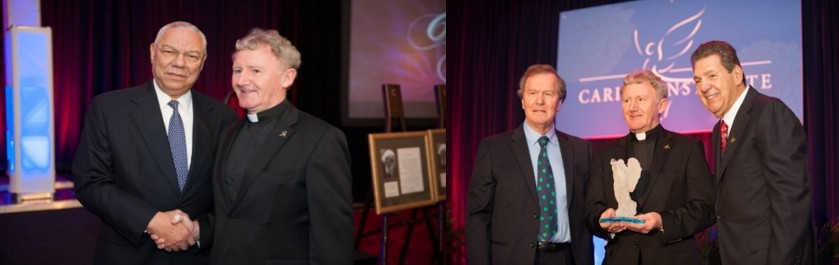
Rev. Dr. Patrick Devine, Shalom-SCCRR with Glenn Kielty (L) and Val J Halamandaris (R), Founder and Executive Director of the Caring Institute, receiving the International Caring Award for sustainable peace and development efforts throughout Africa. On the left is General Colin Powell, Former United State Secretary of State who was the guest of honor at the Ceremony.
Shalom-SCCRR’s approach has consistently distinguished itself from many conventional peacebuilding models through its highly qualified team, constancy and persistence of presence in the conflict environments, integration of research, structured negotiation, local ownership, education, leadership empowerment, and conflict-sensitive humanitarian programming. Unlike externally imposed interventions, Shalom-SCCRR prioritizes the dignity, aspirations, and agency of communities themselves, ensuring that peacebuilding emerges from within the social fabric of affected populations.
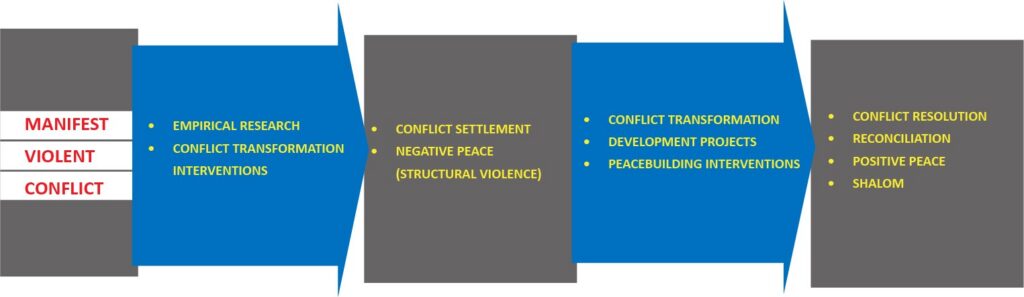
Shalom’s unique approach has earned the organization remarkable recognition from major regional and international institutions. The United Nations Information Centre (UNIC) acknowledged the organization’s contribution by stating:
“Shalom Center for Conflict Resolution and Reconciliation is well known to the United Nations Information Centre (UNIC). The Shalom Center for Conflict Resolution and Reconciliation works to end cycles of violence in the tribal lands of Eastern Africa. We therefore have no hesitation in recommending them for the United Nations Department of Public Information accreditation with the confidence that they will be a great asset and add value to the United Nations work.”
This endorsement reflects the United Nations’ recognition of Shalom-SCCRR not merely as an implementing organization, but as a credible strategic partner contributing meaningfully to global peacebuilding efforts. Today, as an accredited member of the United Nations system, Shalom-SCCRR collaborates with UN departments, international NGOs, governments, faith institutions, and academic bodies working toward sustainable peace, justice, and development.
Equally significant has been the organization’s partnership with the Intergovernmental Authority on Development (IGAD), which recognized the professionalism and effectiveness of Shalom-SCCRR’s methodology. IGAD affirmed:
“Shalom distinguishes itself by its unique way of working, incorporating theory through research and practice through training on skills in conflict resolution and transformation. The organization has a growing reputation for its peacebuilding work, professionalism, high research ability and conflict sensitivity. Its well-structured training modules on analytical skills and knowledge of peacebuilding are a major contributor to our work. Shalom is unquestionably an exceptional organization to partner with. Shalom-SCCRR’s experience in the region suggests that the UN and it would greatly benefit from this association.”
Such endorsements are a reflection of Rev. Dr. Patrick Devine’s visionary leadership and his ability to build strategic partnerships that connect grassroots communities with regional and international policy actors. Through collaborative engagements with institutions such as IGAD, East Africa governments, the United Nations, diplomatic missions, universities, religious associations and development agencies Shalom-SCCRR has created a unique ecosystem where research, faith leadership, diplomacy, and community empowerment converge to address structural causes of conflict.

Shalom-SCCRR, has twice signed Memoranda of Understanding (MoUs) with the Intergovernmental Agency for Development [IGAD], Eastern Africa (comprised of 8 countries). In photo is H. E. Ambassador Mahboub Maalim, the former Executive Secretary of IGAD and the Shalom-SCCRR Board Members.
One of the defining characteristics of the Shalom-SCCRR International Chairman’s leadership is his unwavering commitment to marginalized populations often neglected in halls of power and global peace-development conversations. Whether among pastoralist communities affected by interethnic conflict, border conflicts, religious ideological extremism, violence against women, children and minorities, political-election violence, resource competition, or climate-induced insecurity, his approach consistently emphasizes the primacy of empowered local participation, human dignity, reconciliation, and sustainable development.
For instance, Joe McHugh, Irish Minister for overseas Development who attended EU ministers of Foreign affairs and development meeting in Brussels May 19, 2017 to address the Humanitarian situation in Africa, Yemen and Syria recognized the Shalom-SCCRR remarkable impacts in his own words saying, “I also pointed out to the great work that is being done in the Northern Kenya by a group called Shalom – inter-ethnic conflict reconciliation- where for the first time in a particular region, even with doubt and massive challenges, peace is holding, so we have to look at the solutions.”
His work demonstrates that effective peacebuilding cannot be detached from education, livelihoods, resilience, governance, social cohesion, and institutional strengthening. Through schools, peace committees, women and youth empowerment programs, leadership training initiatives, conflict analysis forums, and structured negotiation processes, Shalom-SCCRR has transformed countless communities across Kenya, South Sudan, Ethiopia, Uganda, Somalia, and other parts of Eastern and Central Africa.
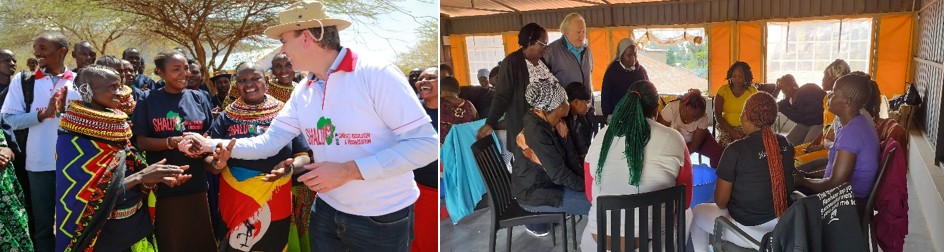
Ireland’s Overseas Development Minister, Joe McHugh with an international delegation visiting Shalom-SCCRR’s conflict transformation interventions and schools’ construction and educational development projects in Samburu County, Kenya.
A key aspect of the Shalom-SCCRR International Chairman’s diplomatic engagement lies in his ability to ensure that the voices and experiences of remote communities are represented in national, regional and global policy spaces. By engaging government agencies, ambassadors, UN officials, regional blocs, religious leaders, and international partners, he has consistently advocated for policies and interventions that are informed by realities on the ground rather than abstract political assumptions. Shalom-SCCRR is a living proof of effective conflict transformation and peacebuilding interventions in conflict environments.
His collaboration with distinguished political and diplomatic actors over the years has further highlighted the growing international confidence in Shalom-SCCRR’s contribution to global peace and security agendas. These relationships have strengthened international support for locally driven conflict transformation-peacebuilding initiatives and reinforced the importance of community-centered approaches in preventing violent conflict for example, The Shalom Center for Conflict Resolution and Reconciliation (Shalom-SCCRR) was invited by the Association of Member Episcopal Conferences in Eastern Africa (AMECEA) to facilitate a regional forum focused on addressing Religious Ideological Extremism in Eastern Africa. During the engagement, Shalom-SCCRR shared its grassroots-based methodology for intervention, emphasizing conflict transformation, community dialogue, preventive peacebuilding, youth engagement, interreligious collaboration, and locally driven reconciliation mechanisms. The invitation reflected growing regional recognition of Shalom-SCCRR’s practical and research-informed approaches in countering extremism and strengthening peaceful coexistence across vulnerable communities in Eastern Africa.
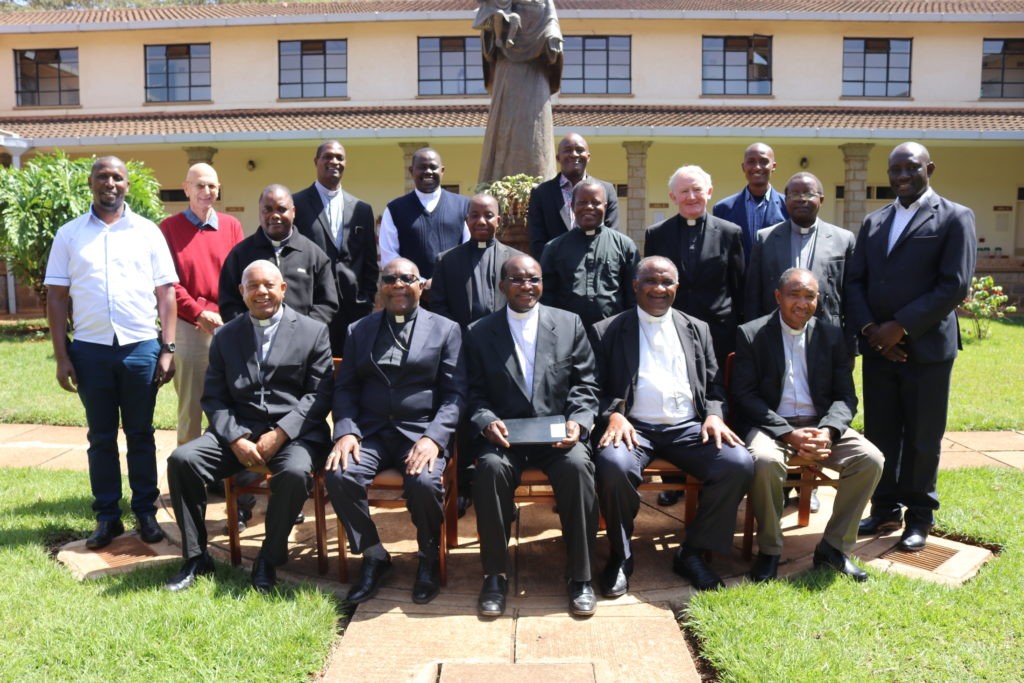
AMECEA Personnel from Kenya, Malawi, and Tanzania, with Shalom-SCCRR team members, Mr. Godfrey Okoth, Rev. Dr. Patrick Devine, and Mr. Francis Mwangi during the first day of the forum.
Beyond diplomacy, the Shalom-SCCRR International Chairman remains deeply connected to grassroots communities. While acknowledging his valuable participation in global forums, he continually prioritizes direct engagement with people living in some of Africa’s most fragile and underserved regions, be they remote terrains or in the appalling slums around cities like Nairobi. This ability to authentically bridge local realities with international diplomacy is what makes his leadership particularly exceptional. He embodies a model of servant leadership where global recognition does not replace grassroots commitment but rather amplifies it.
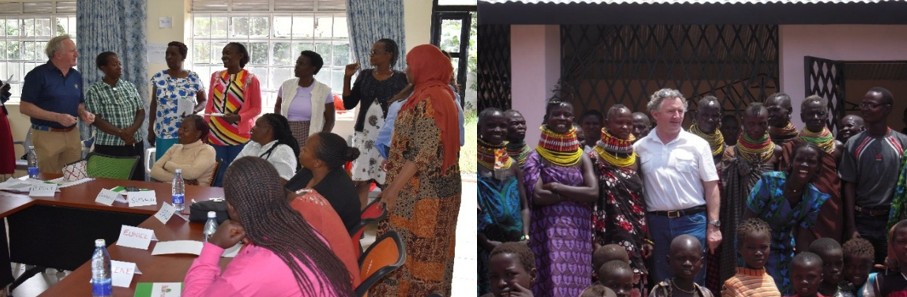
Shalom-SCCRR’s International Chairman, at the grassroots, envisioning a way forward for Conflict transformation and how women can be empowered and involved actively.
As violent extremism, climate insecurity, political instability, displacement, and social fragmentation continue to challenge many regions of Africa and the world, the Shalom-SCCRR model offers important lessons for contemporary conflict transformation, peacebuilding and sustainable development intervention and practice orientations. Its integration of empirical research, local ownership, conflict sensitivity, humanitarian action, faith-based engagement, education, and diplomacy presents a holistic framework capable of addressing both immediate manifest violence and long-term structural drivers of conflict.
The growing international recognition of the Shalom-SCCRR methodology and rationale is therefore not accidental. It is the result of decades of consistent engagement, credible research, ethical leadership, strategic partnerships, and measurable impact among communities most affected by violence and structural marginalization.
Through authentic leadership, management, strategic interventions, and evidence-based results, the Shalom-SCCRR International Chairman continues to position Shalom-SCCRR as a globally respected institution. The work of Shalom-SCCRR demonstrates that sustainable peace is possible when conflict affected communities are adeptly empowered, the dignity of life is honored and non-negotiable, and local realities are integrated into national, regional, and international conflict transformation and peacebuilding frameworks.
Author:
Mr. John Kennedy Odhiambo, MA, Shalom-SCCRR Project Officer, Team Leader
Relevant Links:
- Shalom-SCCRR 16 Years Results and Achievements.
https://shalomconflictcenter.org/wp-content/uploads/2026/04/16-Years-Shalom-SCCRR-Results-and-Achievements-LV.pdf - Eastern Africa: Shalom-SCCRR receives United Nations (UN) Accreditation.
https://shalomconflictcenter.org/3901-2/ - Shalom-SCCRR Methodology and Interventions Amplified: Holy See advises UN; Integral Human Development is a path to lasting peace, by Matt Moran.
https://shalomconflictcenter.org/holy-see-advises-un-integral-human-development-is-a-path-to-lasting-peace/ - IGAD. IGAD Signs an Updated MoU with Shalom Center.https://igad.int/igad-signs-an-updated-mou-with-shalom-center/
- Shalom-SCCRR. (2018). IGAD Endorses Shalom- SCCRR for United Nations Accreditation. https://shalomconflictcenter.org/igad-endorses-shalom-sccrr-for-united-nations-accreditation/
- Submission to Public Consultation on the Irish Aid White Paper. https://shalomconflictcenter.org/submission-to-public-consultation-on-the-irish-aid-white-paper/
- Shalom-SCCRR Brochure.
https://shalomconflictcenter.org/wp-content/uploads/2026/01/Shalom-SCCRR-Brochure-2025.pdf - Rev. Dr. Patrick Devine; Shalom-SCCRR Chairman’s Report for 2025. https://shalomconflictcenter.org/rev-dr-patrick-devine-shalom-sccrr-chairmans-report-for-2025/
- Shalom-SCCRR Chairman’s Report for 2025; Rev. Dr. Patrick Devine with pictures, captions, and links added by the Shalom-SCCRR Communication Department. https://shalomconflictcenter.org/shalom-sccrr-chairmans-report-for-2025-rev-dr-patrick-devine/
- Devine, Patrick R. (2025). Shalom-SCCRR’s Conflict Transformation and Peacebuilding Intervention Methodology, Processes and Spiritual Rationale (Synopsis) with 16 years Results.
https://shalomconflictcenter.org/shalom-sccrr-intervention-methodology-conflict-management-continuum-diagram-and-a-brief-rationale-overview-with-16years-results/ - 2025 School/Educational Development Results and Achievements.
https://shalomconflictcenter.org/2025-school-educational-development-results-and-achievements/ - 2025 Conflict Transformation & Peacebuilding Results and Achievements.
https://shalomconflictcenter.org/2025-conflict-transformation-peacebuilding-results-and-achievements/ - 2025 Shalom Empowerment Center (SEC) Addressing Violence Against Women and Children Results and Achievements.
https://shalomconflictcenter.org/2025-shalom-empowerment-center-sec-addressing-violence-against-women-and-children-results-and-achievements/ - Democratic Republic of Congo (DRC): Raising the Shalom-SCCRR Banner Amid Its Violent Conflict Eastern Region, By Rev. Dr. Emmanuel T. Tembo.
https://shalomconflictcenter.org/democratic-republic-of-congo-drc-raising-the-shalom-sccrr-banner-amid-its-volatile-conflict-eastern-region/ - Launching Forth with Noble Expectations: the ‘Center for Conflict Transformation and Peacebuilding’ (CCTPB) in Tanzania, East Africa
https://shalomconflictcenter.org/launching-forth-with-noble-expectations-the-center-for-conflict-transformation-and-peacebuilding-cctpb-in-tanzania-east-africa/ - Kitonga, D. M., Ndiga, B., & Noonan, O. (2025). Contributions of Social Community Structures on Conflict Management among Pastoral Communities in the Ilemi Triangle. Eastern African Journal of Humanities and Social Sciences, 4(1), 68-76. https://doi.org/10.58721/eajhss.v4i1.874
- Devine, R. P. (2026). The Ilemi Triangle Environs: Delineating the Causes and Consequences of the Turkana-Dassenach Conflict (2nd Edition). India: Notion Press. https://notionpress.com/in/read/the-ilemi-triangle-environs-hardcover?srsltid=AfmBOorDxQeYEJjpPnBpCProynUIT0XUHqCRqs4MqlYgGV0KzsS_F9m4
- Devine, R. P. (2025). Persistent conflict between the Pokot and the Turkana (2nd Edition). India: Notion Press. https://www.barnesandnoble.com/w/persistent-conflict-between-the-pokot-and-the-turkana-patrick-r-devine/1147446777
- Devine, P. R. (2025). Conflict and Religion in Eastern Africa: A Conceptual Consideration of Radicalisation, Fundamentalism, Extremism, Terrorism, Tolerance, and Their Interaction Dynamics. https://shalomconflictcenter.org/wp-content/uploads/2025/07/Patrick-Devine-Tangaza-Journal-Conflict-and-Religion-in-Eastern-Africa-Jun-2025.pdf
- Okoth, G. & Mwangi, F. (2022). Shalom-SCCRR Facilitates at AMECEA Forum on Addressing Religious Ideological Extremism in Eastern Africa. https://shalomconflictcenter.org/shalom-sccrr-facilitates-amecea-forum-on-addressing-religious-ideological-extremism-in-eastern-africa/
- Rev. Dr. Patrick Devine 2025 International Lectures and Presentations.
https://shalomconflictcenter.org/rev-dr-patrick-devine-2025-international-lectures-and-presentations/