By: Kennedy Otieno.
Greetings, I am delighted to share this article with you.
As the Shalom-SCCRR Transport and Delivery Officer, I lead logistics coordination efforts while collaborating with project teams in volatile and high-risk environments to drive the delivery of humanitarian, peace and development interventions in conflict-affected and fragile contexts, ensuring the rapid, secure, and dependable distribution of critical life-saving resources to crisis-affected communities.
Shalom-SCCRR marks 16 years of work in Eastern Africa, and the results built on leadership, dedication, professionalism and teamwork are truly inspirational. In that time, 802 School-Educational development projects across 452 institutions have been supported and Completed, directly benefiting 249,333 pupils and students whereby, over half of them are girls.
39,615 influential peace actors (chiefs, elders, religious leaders, women, youth, and security personnel) have been Empowered. 1,296 conflict transformation and peacebuilding training workshops in 36 volatile conflict locations have been implemented.
In Peace Education, over 168,000 empowered pupils and students are being engaged in Conflict transformation across 59 established active School Peace Clubs.
37 Health and Medical centres located in the most marginalized and conflict-affected areas of Northern Kenya and South Sudan were supported with vital medical equipments.
A big cultural shift has been the empowerment of women within Shalom’s programmes. For instance, in 2025, 62% of participants were women, up from a mere 2% when Shalom was founded in 2009. A tremendous validation felt by them for their dignity, competency, and capacity for leadership.
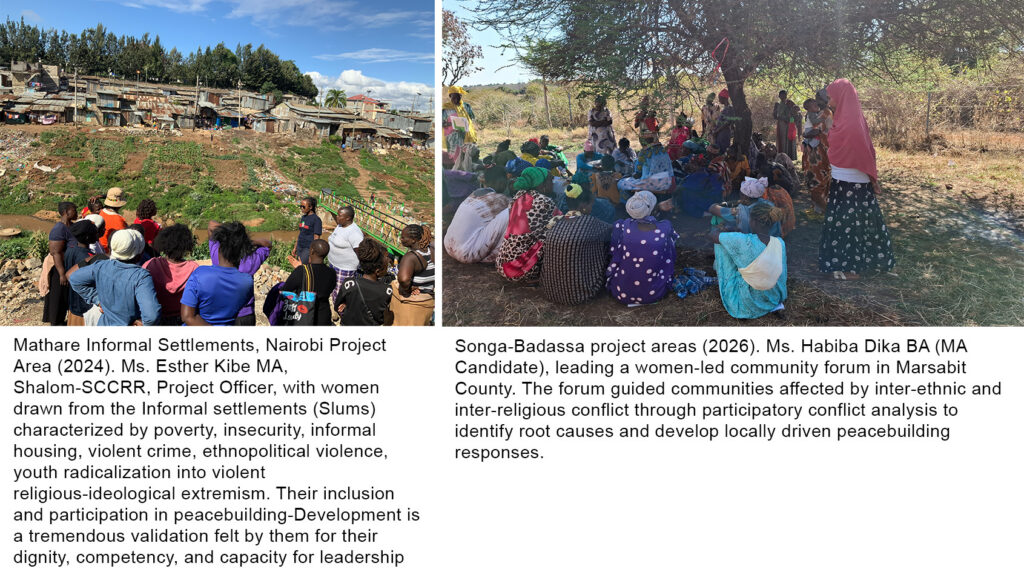
This reflects a 73% program success rate in preventing and mitigating violent inter-ethnic conflicts through locally developed early warning systems, reinforcing sustainable peace, social cohesion, and inclusive development.
Shalom Centre for Conflict Resolution and Reconciliation (SCCRR) is an inter-religious peacebuilding non-governmental organisation that works in Africa. Specifically, the Eastern Africa member countries of Intergovernmental Authority on Development (IGAD). Its main objective is to attain conflict resolution for all people in Africa through empowering local communities engaged in inter-ethnic conflict, and/or wherein religious ideological extremism is espoused, to be architects of their own interdependent future reconciled co-existence.
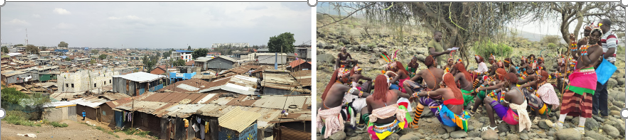
Shalom-SCCRR has its sustainable peacebuilding and development tentacles spread in more than 36 volatile and marginalized conflict environments such as; Marsabit, Turkana, Samburu, West Pokot, Kisumu-Nandi, Mombasa Counties and cross-border areas of Ethiopia and South Sudan, including Democratic Republic of Congo that presents significant operational challenges.
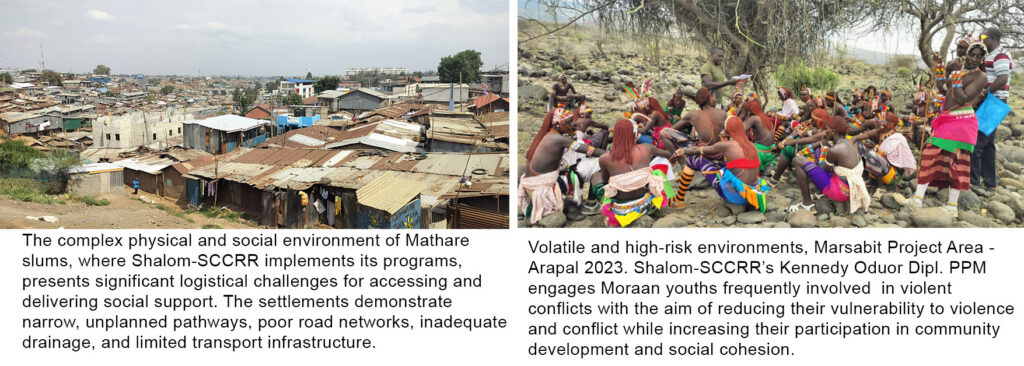
In order to overcome related field operational challenges, logistics design has extended far beyond technical and operational function of movement and delivery, its contribution has progressively formed the critical bridge between communities in need and affected by conflict and, the Shalom-SCCRR’s peacebuilding, humanitarian, and development initiatives designed to restore stability, dignity, and sustainable coexistence.
My effective involvement and experience in the Logistics Department offered a unique perspective on the indispensable role of logistics in enabling Shalom-SCCRR’s peacebuilding and social development initiatives. Through this role, I observed how effective logistical coordination contributed to the timely and efficient delivery of programs to benefit conflict-affected communities.
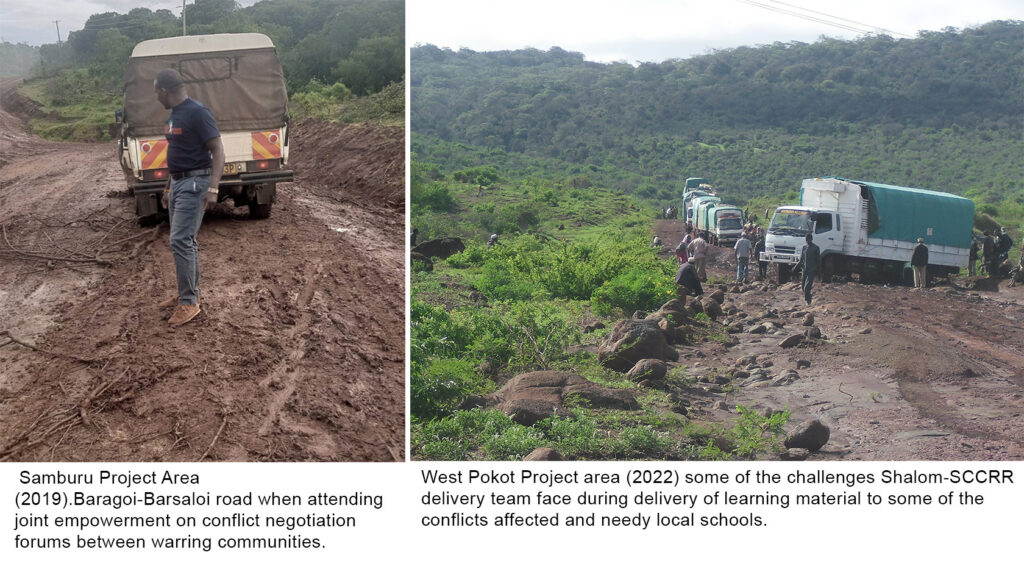
These regions are frequently characterized by intercommunal conflicts, resource-based violence, livestock raiding, weak infrastructure-institutional neglect-limited state presence (structural violence), harsh climatic conditions, and poor communication networks. In many instances, accessing remote communities involves travelling thousands of miles through challenging conditions, including flood-prone seasonal rivers, rough terrain, vast semi-arid landscapes, and insecure routes vulnerable to armed conflict and banditry.
Practical experience gained throughout these years has enhanced my skills and knowledge in logistical operations demand such as; continuous risk assessment, adaptability, strategic teamwork planning, and close coordination with local leaders, elders, security agencies, and community peace structures.
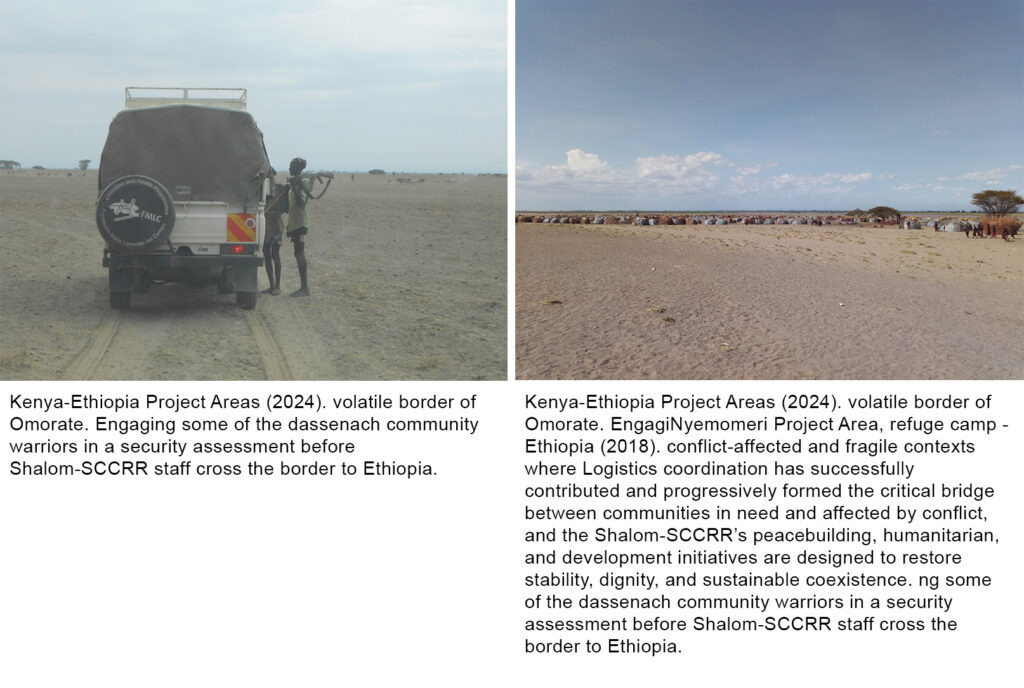
Over the past 16 years, the integration of logistics has significantly supported and successfully realized achievements recorded in peacebuilding, educational development, women’s empowerment and humanitarian interventions.
This has been achieved through timely delivery of construction materials for the 802 classroom construction and renovations, supplemented with teaching and learning materials, solar panels, desks, lockers, medical equipment, personal protective equipment, and water supply items to schools, health facilities, and other social amenities in remote and underserved areas.
These interventions have reached locations in Kenya, Sudan, South Sudan, Ethiopia, Tanzanian, Somalia and D.R.Congo, most notably in cross-border regions of Kenya, Uganda, South Sudan, and Ethiopia. Within Kenya major interventions continue in the Kerio-Valley volatile areas of Elgeyo-Marakwet and Baringo, Marsabit, Turkana, Samburu, West Pokot, Nakuru, Kisumu, Nandi, Mombasa, Isiolo, and, strengthening service delivery in some of the most conflict-affected settings.

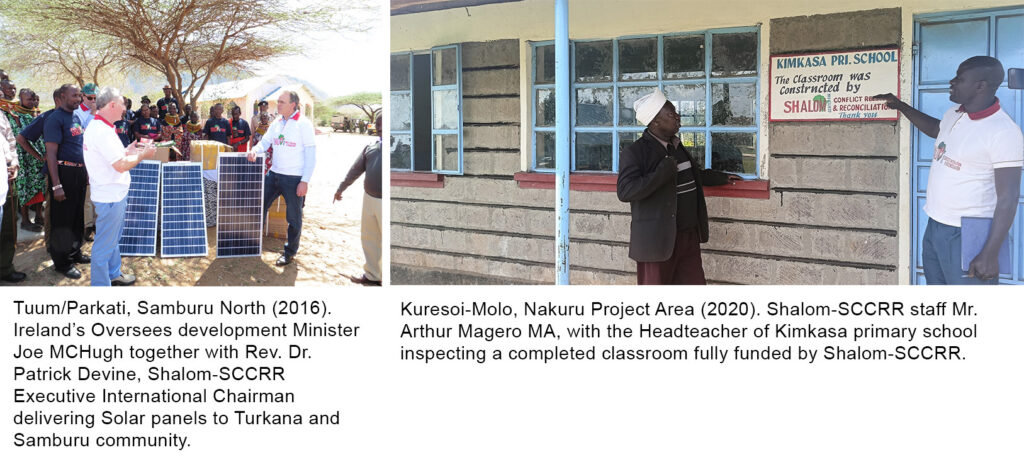
These interventions have reached locations in Kenya, Sudan, South Sudan, Ethiopia, Tanzanian, Somalia and D.R.Congo, most notably in cross-border regions of Kenya, Uganda, South Sudan, and Ethiopia. Within Kenya major interventions continue in the Kerio-Valley volatile areas of Elgeyo-Marakwet and Baringo, Marsabit, Turkana, Samburu, West Pokot, Nakuru, Kisumu, Nandi, Mombasa, Isiolo, and, strengthening service delivery in some of the most conflict-affected settings.
In 2025 Shalom-SCCRR’s Interventions, Results and Achievements: 159 Conflict transformation and Peacebuilding training workshops were implemented with Peace Groups consisting of influential opinion shapers in the urban informal settlement conflict hotspots and marginalized areas.
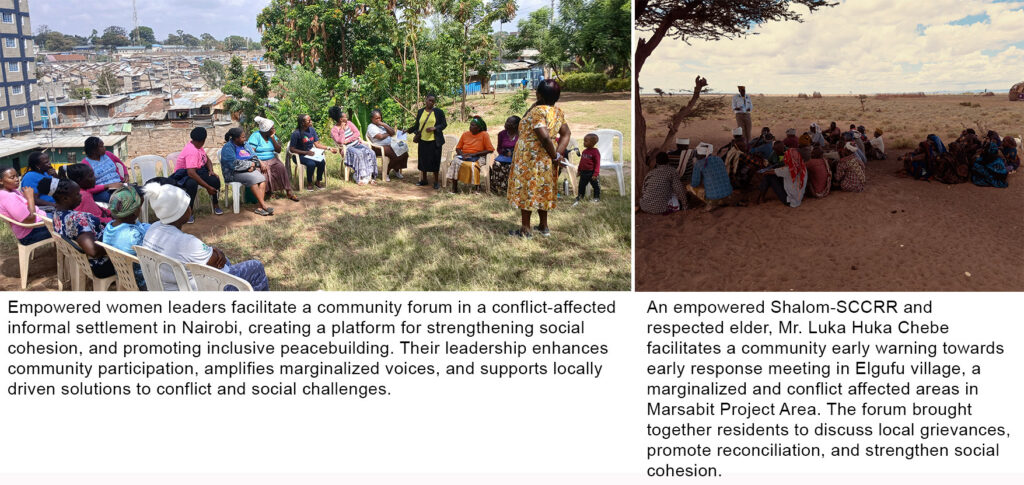
5,591 Peace groups members trained and benefited on conflict analysis, leading to the design and implementation of locally driven and sustained conflict transformation and peacebuilding initiatives.
16 Training Workshops on prevention of Religious Ideological Extremism were implemented in 7 project areas located in Nairobi and Mombasa informal settlements/slums in Kenya.
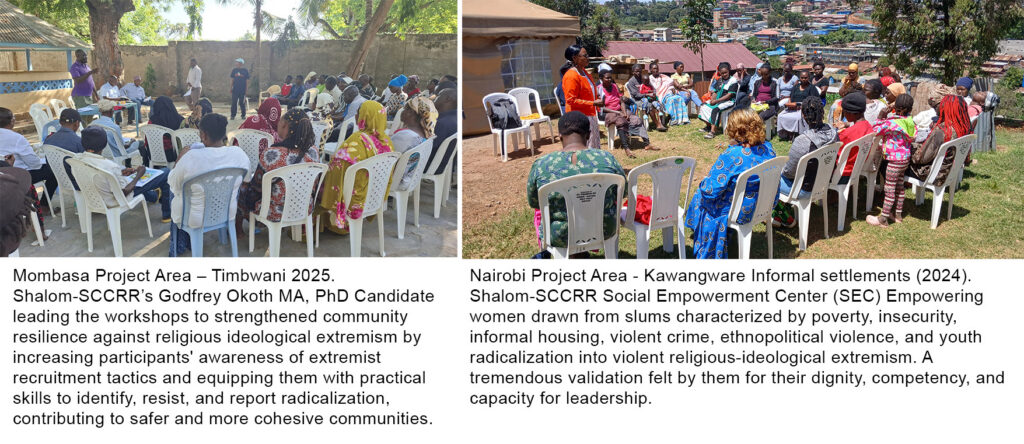
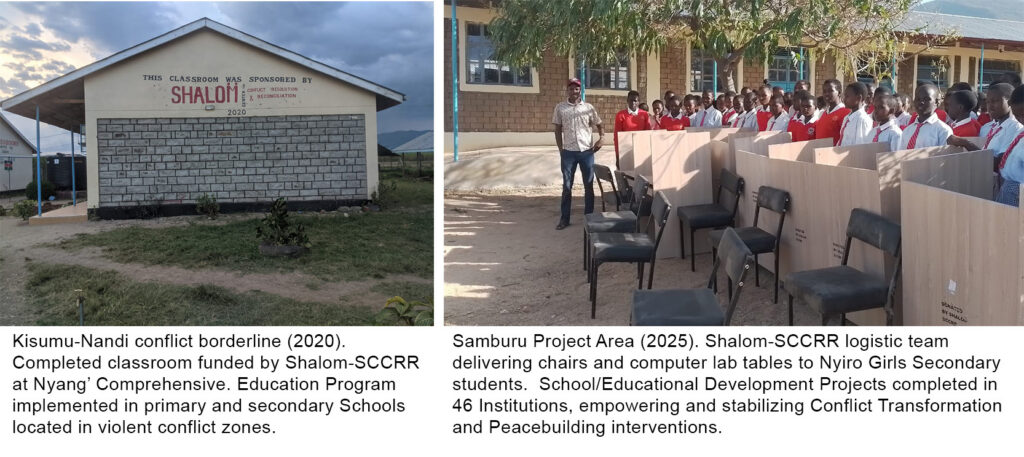
In School programs, 70 School/Educational Development Projects completed in 46 Institutions, empowering and stabilizing Conflict Transformation and Peacebuilding interventions.
26,770 Pupils and Students benefiting from the 70 Shalom-SCCRR-funded projects: Classrooms, Accommodation facilities, Solar lighting systems, Gender sanitary items, Books, Desks, School Water systems, Science Laboratory Equipment.
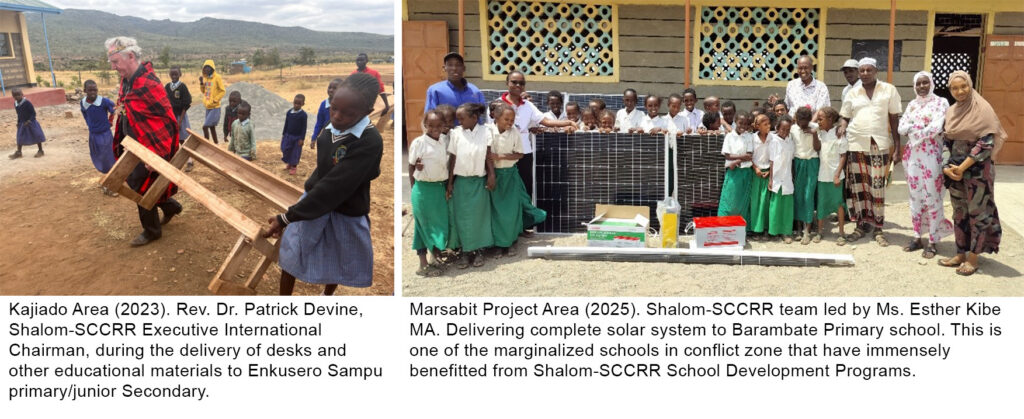
18,500 Pupils and Students benefiting from the Shalom-SCCRR Peace Education Program implemented in primary and secondary Schools located in violent conflict zones.
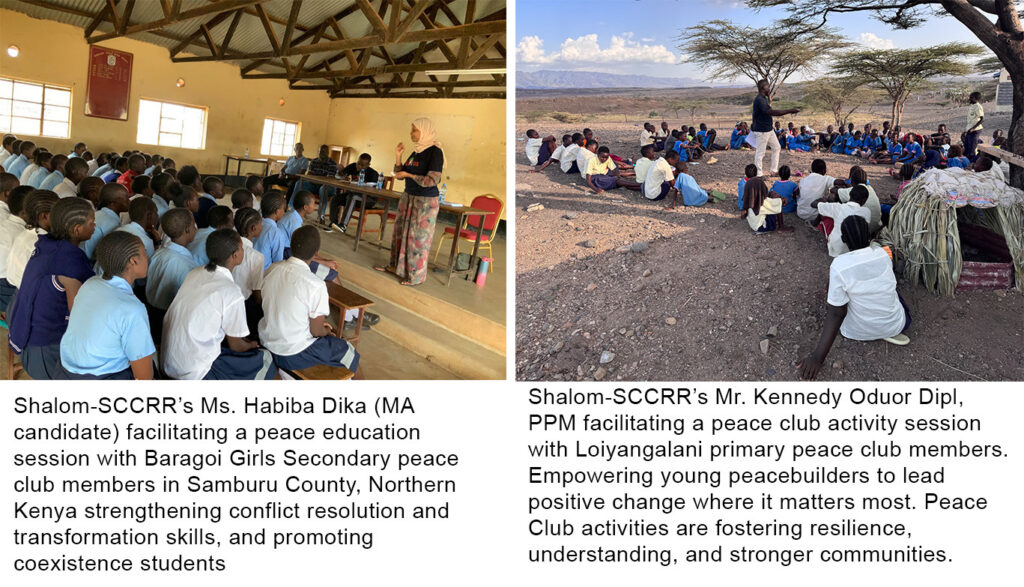
Beyond operational coordination, working within these fragile contexts has also provided valuable lessons and professional growth. The logistics function in conflict-affected regions demands resilience, teamwork, emergency response skills, conflict-sensitive planning, stakeholder engagement, and adaptive leadership.
Experience gained in the Shalom-SCCRR logistics department and interaction with beneficiary communities inspired me to pursue further studies, strengthening my skills in Project Management, Sustainable Livelihood Programming and logistics Management.
It has also deepened my understanding of the interconnected relationship between conflict transformation, peace, development, and positive life-giving social change. In conflict-prone regions, sustainable peace cannot be achieved solely through dialogue or humanitarian assistance in isolation; it requires integrated systems capable of supporting communities consistently and effectively even under the most difficult circumstances.

The families and communities benefitting from Shalom-SCCRR peace, reconciliation and development work are continually ecstatic in offering thanks to the generosity and care of the Shalom supporters particularly in the USA, Ireland, UK, Australia, among others.
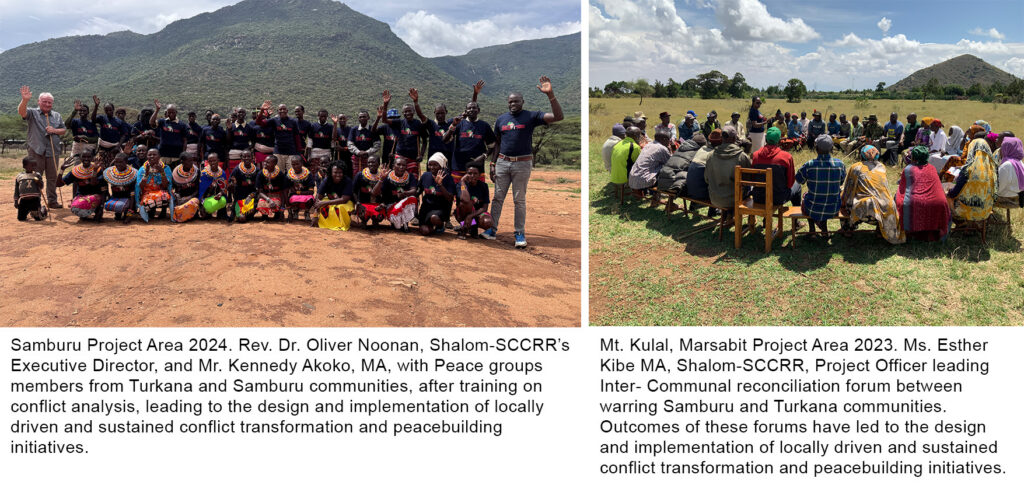
At the recently concluded Shalom Charity Golf Classic held at the Palmer South Course in the K-Club, Rev. Dr. Patrick Devine, International Chairman of Shalom-SCCRR, expressed deep appreciation to all donors and businesses worldwide on behalf of the Shalom-SCCRR fraternity and beneficiary communities, stating: “Shalom-SCCRR identifies with your own business models in believing that ‘theory without practice is empty, and practice without theory is blind’. Your presence with us is never taken for granted. We honor you each day, in action, with the men and women in Africa who put their sweat and tears into settling conflicts, building lasting peace, digging foundations, mixing concrete, and carrying equipment on their heads and shoulders across hot, semi-arid terrains and through the narrow lanes of urban slums.”
He also emphasized how social and religious values such as peace, truth, justice, and mercy can now take deep communal root, educational, medical, and water development interventions are sustainable, the dignity of life is safeguarded, and moreover, families-communities can experience the ‘Divine Presence” in their daily lives deeply as we would all wish; “long may the success continue thanks to you and the Shalom team on the front line in Africa”
Author: Mr. Kennedy Oduor Otieno Dipl. PPM, Shalom-SCCRR Transport and Delivery Officer
Relevant Links
- Shalom-SCCRR 16 Years Results and Achievements.
https://shalomconflictcenter.org/wp-content/uploads/2026/04/16-Years-Shalom-SCCRR-Results-and-Achievements-LV.pdf - Kipruto, K. & Ndiema, R. Remmy. (2025, October 6). Stewardship at the Shalom Center for Conflict Resolution and Reconciliation (SCCRR). https://shalomconflictcenter.org/stewardship-at-the-shalom-center-for-conflict-resolution-and-reconciliation-sccrr/
- 2025 School/Educational Development Results and Achievements.
https://shalomconflictcenter.org/2025-school-educational-development-results-and-achievements/ - Devine, Patrick R. (2025). Shalom-SCCRR’s Conflict Transformation and Peacebuilding Intervention Methodology, Processes and Spiritual Rationale (Synopsis) with 16 years Results.
https://shalomconflictcenter.org/shalom-sccrr-intervention-methodology-conflict-management-continuum-diagram-and-a-brief-rationale-overview-with-16years-results/ - Rev. Dr. Patrick Devine; Shalom-SCCRR Chairman’s Report for 2025. https://shalomconflictcenter.org/rev-dr-patrick-devine-shalom-sccrr-chairmans-report-for-2025/
- Shalom-SCCRR Chairman’s Report for 2025; Rev. Dr. Patrick Devine with pictures, captions, and links added by the Shalom-SCCRR Communication Department. https://shalomconflictcenter.org/shalom-sccrr-chairmans-report-for-2025-rev-dr-patrick-devine/
- 2025 Conflict Transformation & Peacebuilding Results and Achievements.
https://shalomconflictcenter.org/2025-conflict-transformation-peacebuilding-results-and-achievements/ - 2025 Shalom Empowerment Center (SEC) Addressing Violence Against Women and Children Results and Achievements.
https://shalomconflictcenter.org/2025-shalom-empowerment-center-sec-addressing-violence-against-women-and-children-results-and-achievements/ - Kibe, E. (2026, June 27). Rev. Dr. Patrick Devine’s Presentation at the Tangaza University, School of Philosophy Symposium.
https://shalomconflictcenter.org/rev-dr-patrick-devines-presentation-at-the-tangaza-university-school-of-philosophy-symposium/ - John Kennedy (2026, June 18). Some of the Global Recognition of Shalom-SCCRR’s Conflict Transformation-Peacebuilding Approach. https://shalomconflictcenter.org/the-global-recognition-of-shalom-sccrrs-conflict-transformation-peacebuilding-approach/
- Ngala, C & Osiro, M. (2026, June 22). Conflict Transformation-Hope Realized: My Journey with Shalom-SCCRR’s Peacebuilding in Mathare Slum, Nairobi, Kenya. https://shalomconflictcenter.org/conflict-transformation-hope-realized-my-journey-with-shalom-sccrrs-peacebuilding-in-mathare-slum-nairobi-kenya/
- Butler, J. (Oct, 2023). Harvard Kennedy School; A Conversation with Rev. Dr. Patrick Devine and Paula Soumaya Domit. https://shalomconflictcenter.org/wp-content/uploads/2024/01/Harvard_Kennedy_School_Article_WITH_PHOTOS_MAP_1_17_24_FINAL.pdf
- Shalom-SCCRR. (2025, Oct 3). Rev. Dr. Patrick Devine 2025 International Lectures and Presentations. https://shalomconflictcenter.org/rev-dr-patrick-devine-2025-international-lectures-and-presentations/
- Devine, Patrick R. (2025). Conflict and Religion in Eastern Africa: A Conceptual Consideration of Radicalization, Fundamentalism, Extremism, Terrorism, Tolerance, and Their Interaction Dynamics.
https://shalomconflictcenter.org/rev-dr-patrick-devine-conflict-and-religion-in-eastern-africa-a-conceptual-consideration-of-radicalisation-fundamentalism-extremism-terrorism-tolerance-and-their-interaction-dynamics/ - Okoth, G. & Mwangi, F. (2022). Shalom-SCCRR Facilitates at AMECEA Forum on Addressing Religious Ideological Extremism in Eastern Africa. https://shalomconflictcenter.org/shalom-sccrr-facilitates-amecea-forum-on-addressing-religious-ideological-extremism-in-eastern-africa/
- Kitonga, D. M., Ndiga, B., & Noonan, O. (2025). Contributions of Social Community Structures on Conflict Management among Pastoral Communities in the Ilemi Triangle. Eastern African Journal of Humanities and Social Sciences, 4(1), 68-76. https://doi.org/10.58721/eajhss.v4i1.874
- Devine, R. P. (2026). The Ilemi Triangle Environs: Delineating the Causes and Consequences of the Turkana-Dassenach Conflict (2nd Edition). India: Notion Press. https://notionpress.com/in/read/the-ilemi-triangle-environs-hardcover?srsltid=AfmBOorDxQeYEJjpPnBpCProynUIT0XUHqCRqs4MqlYgGV0KzsS_F9m4
- Devine, R. P. (2025). Persistent conflict between the Pokot and the Turkana (2nd Edition). India: Notion Press. https://www.barnesandnoble.com/w/persistent-conflict-between-the-pokot-and-the-turkana-patrick-r-devine/1147446777